You may have heard about BNB Chain, created by the world’s largest cryptocurrency exchange. The chain, which is the result of a merger of Binance Chain and BNB Smart Chain, has won kudos for its ability to swiftly process transactions while charging low fees. The company, however, currently faces a number of legal and regulatory issues. Read on to learn more about this important player in the world of blockchains.
What is BNB Chain?
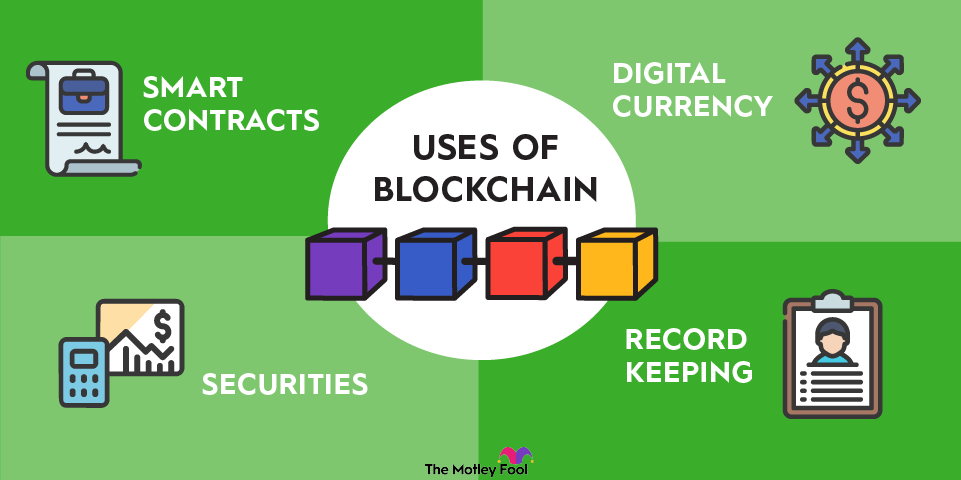
BNB Chain is a blockchain created by Binance (BNB -0.22%), the world’s largest cryptocurrency exchange by trading volume. The blockchain is fueled by BNB, formerly known as Binance coin. It’s a decentralized, open-source ecosystem that helps users create, store, and exchange data. It supports smart contracts, or programs on a blockchain that automatically execute when certain conditions are met.
BNB Chain has its roots in the 2017 founding of Binance by Changpeng Zhao, a Chinese-Canadian software developer, and Yi He, a Chinese businesswoman. The BNB Chain was created by the 2022 merger of Binance Chain, which handled staking and governance, and BNB Smart Chain, an Ethereum-compatible smart contract platform. The blockchain uses a proof-of-stake system to validate transactions and govern the network, and it was designed as a high-performance blockchain for smart contracts that would be compatible with the Ethereum Virtual Machine (EVM).
How is BNB Chain used?
BNB Chain claims to be among the most popular blockchains in the world, recording 4 million daily transactions and more than 1.4 million contracts, according to BSCScan and Solidus Labs. It’s thought to be a low-cost, fast alternative to Ethereum (ETH -0.09%).
The BNB Chain’s native cryptocurrency, BNB, has a market cap of almost $50 billion, trailing only Bitcoin (BTC -0.32%), Ethereum, and Tether (USDT -0.01%). There’s a vast array of decentralized applications (dApps) available on the platform; the applications are programs that operate on peer-to-peer networks and blockchains rather than central servers. BNB claimed more than 4,700 dApps on the blockchain as of mid-2023.
Social Media
Although decentralized apps are often used for social media and gaming purposes, some of the most attractive uses are made in finance. Investors who loan money on a dApp, for example, generally get higher interest rates than if they loan money to a bank since there aren’t any intermediaries. Borrowers also can negotiate rates with lenders, which isn’t always the case for people shopping for a loan. Finally, a smart contract can allow the transaction to take place immediately since no lawyers or other third parties are involved.
Getting started on the BNB Chain is an easy, three-step process:
- Download a crypto wallet to connect to BNB Chain and manage funds;
- Get BNB, the BNB Chain currency; and
- Find a dApp that you want to use, a game you want to play, or another application that looks interesting.
Pros and cons of BNB Chain
Like any other blockchain ecosystem, there are advantages and disadvantages to BNB Chain. And while we generally like to present the pros first, the BNB Chain had some big cons in mid-2023. First and foremost, its parent company Binance Holdings has been charged by the Securities and Exchange Commission with failing to register its tokens and failing to register its platform before its 2017 initial coin offering (ICO).
The SEC investigation isn’t unique to Binance. Ripple Labs (XRP -0.30%), for example, has been fighting with the SEC over whether its token should be considered a security. But the SEC also has charged Binance with a number of securities violations, citing co-founder Zhao’s control of Sigma Chain AG and Merit Peak Ltd., trading firms that act as market makers on the Binance platform. The SEC claims the two firms received unfair speed and access advantages, and it alleges Binance commingled billions of investor assets, sending them to the two firms owned by Zhao.
The Commodities and Futures Trading Commission also has weighed in, alleging that Binance traded on its own platform using 300 “house accounts” without disclosing the information to its customers. Zhao described the CFTC filing as “unexpected and disappointing,” noting that the company had been cooperating with the regulator for more than two years.
Finally, there’s the question of security. Although Binance notes that no investor lost money, an October 2022 exploit prompted the company to pause its BNB Smart Chain after hackers made off with more than $100 million. The company promised to alter its governance to prevent further exploits.
To be sure, BNB Chain has some advantages. It supports EVM-compatible smart contracts and other protocols so users from other blockchains can easily migrate their dApps. The blockchain also has cross-chain bridging that allows Tether and Ethereum developers to use it. It supports most popular programming languages and has extensive documentation. The BNB Chain also uses the proof-of-stake method to validate blocks. The method leads to faster transactions, lower gas fees, and a much smaller carbon footprint.
Related investing topics
Example of BNB Chain use
PancakeSwap (CAKE +1.79%) is one of the best-known decentralized exchanges (DEX) on the BNB Chain. It allows users to swap coins without having to pay an intermediary. PancakeSwap focuses on BEP-20 tokens developed by Binance, which announced a “strategic investment” in the exchange in June 2022 for an undisclosed amount.
The exchange has been the network’s largest dApp, with more than 400,000 daily active users and almost $5 billion in total value locked (TVL). PancakeSwap users can also buy and sell non-fungible tokens (NFTs), participate in lotteries, and earn rewards by depositing tokens with PancakeSwap.
Despite its promise, the dApp wasn’t doing so well midway through 2023. In 2021, PancakeSwap was offering rates that topped 100% to investors who staked their native crypto token, CAKE. Prices for the token, however, began plunging in April 2023 after the company proposed slowing the rate of inflation for the token from rates that topped 20% to a range between 3% and 5%. Its market capitalization has fallen from $6.75 billion in April 2021 to about $323 million midway through 2023.
While you can’t draw a straight line from PancakeSwap’s troubles to its location on the BNB Chain, it’s not a good sign when the value of one of a blockchain’s flagship dApps tanks as hard as PancakeSwap. As with any other investment involving cryptocurrency, investors should only spend money that they’re prepared to lose.