Pricing power is a key concept in economics and business, and investors should understand how it manifests and influences competition. Almost every business wants pricing power because it gives them a competitive advantage and allows them to generate higher margins.
Pricing power has a wide range of implications for both businesses and investors and understanding the concept can help you choose better stocks.
What is pricing power?
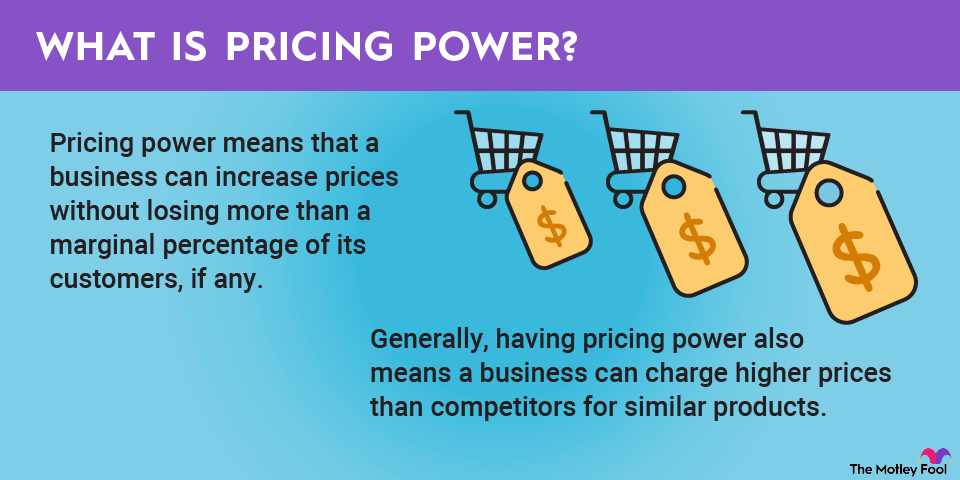
Pricing power is a simple but powerful business concept. It means that a business can increase prices without losing more than a marginal percentage of its customers, if any. Generally, having pricing power also means a business can charge higher prices than competitors for similar products.
Competitive Advantage
Businesses create pricing power through competitive advantages, such as brand or reputation, real or perceived product quality, switching costs, and network effects. Customer satisfaction also allows a business to raise prices over time because people sometimes stick with suppliers they like, even if it means paying higher prices.
Why pricing power is important
Pricing power is an important concept for several reasons. First, it's one of the clearest indicators of competitive advantage. If a business can raise its prices and expand its margins, that's a good sign of competitive advantage. It shows investors that the company should be able to raise prices in the future.
The inflationary environment in 2022 and 2023 has given a number of businesses cover to raise prices, and many have done so successfully with little customer pushback.
Among those companies able to pass along higher prices, demonstrating pricing power, are consumer staples leaders like Coca-Cola (KO -1.37%), PepsiCo (PEP -2.01%), and Procter & Gamble (PG -2.74%).
These companies have been around for generations and have considerable brand equity with consumers worldwide who recognize brands like Coca-Cola, Pepsi, and P&G names like Tide and Gillette.
Pricing power can also show that an industry isn't very competitive. If a business has a monopoly-like market share or relatively little competition, it will be easier for it to demonstrate pricing power.
How to find and invest in companies with pricing power
Now that you understand what pricing power is and why it's so valuable, your next step as an investor is to identify these companies and decide whether you want to own their stocks. The companies above offer good examples of what to look for when searching for businesses with pricing power.
However, there are also financial metrics to focus on. The most important of these is operating margin. Companies with pricing power tend to have high profit margins because they can price their goods or services based on what the market will bear rather than what they cost or what competitors are charging.

One good example is Facebook's parent Meta Platforms. Historically, it has reported an operating margin in the 30% or even 40% range, a reflection of the strong demand for advertising on properties like Facebook and Instagram, as few, if any, social networks have their reach and conversion ability.
Often, management teams will discuss pricing power on earnings calls, especially if they've raised prices recently.
If the company has an easy-to-track consumer product like Netflix, you can also trace its historical pricing to see how it compares with the inflation rate and its peers. A faster price increase would signify pricing power.
Finally, consumer goods like P&G and Coca-Cola generally report price changes, which you can track over time to see how they compare with inflation and whether their operating margins have expanded.
An example of pricing power
One company with a long history of demonstrating pricing power is Walt Disney (DIS -0.72%). The Disney brand has been synonymous with family entertainment for almost a generation. Its legacy and brand equity have allowed it to leverage pricing power in multiple business segments, including theme parks, consumer products, and entertainment such as streaming and live theater.
Related investing topics
The company has consistently raised prices at Disney World and other parks. And despite grumblings from some of its fans, attendance continues to swell to record levels.
Disney has also begun testing its pricing power in its Disney+ streaming service and has seen promising results. It raised its subscription service prices from $7.99/month to $10.99/month, with little customer churn. CEO Bob Iger addressed a question on pricing power on the recent earnings call, saying the company did have "pricing elasticity," another way of saying it can raise prices with little pushback.
Whether you're investing in a bull or bear market, it pays to invest in companies with pricing power. These stocks tend to have proven their worth over a long period and have sound competitive advantages that should drive above-average performances for the long term.
About the Author