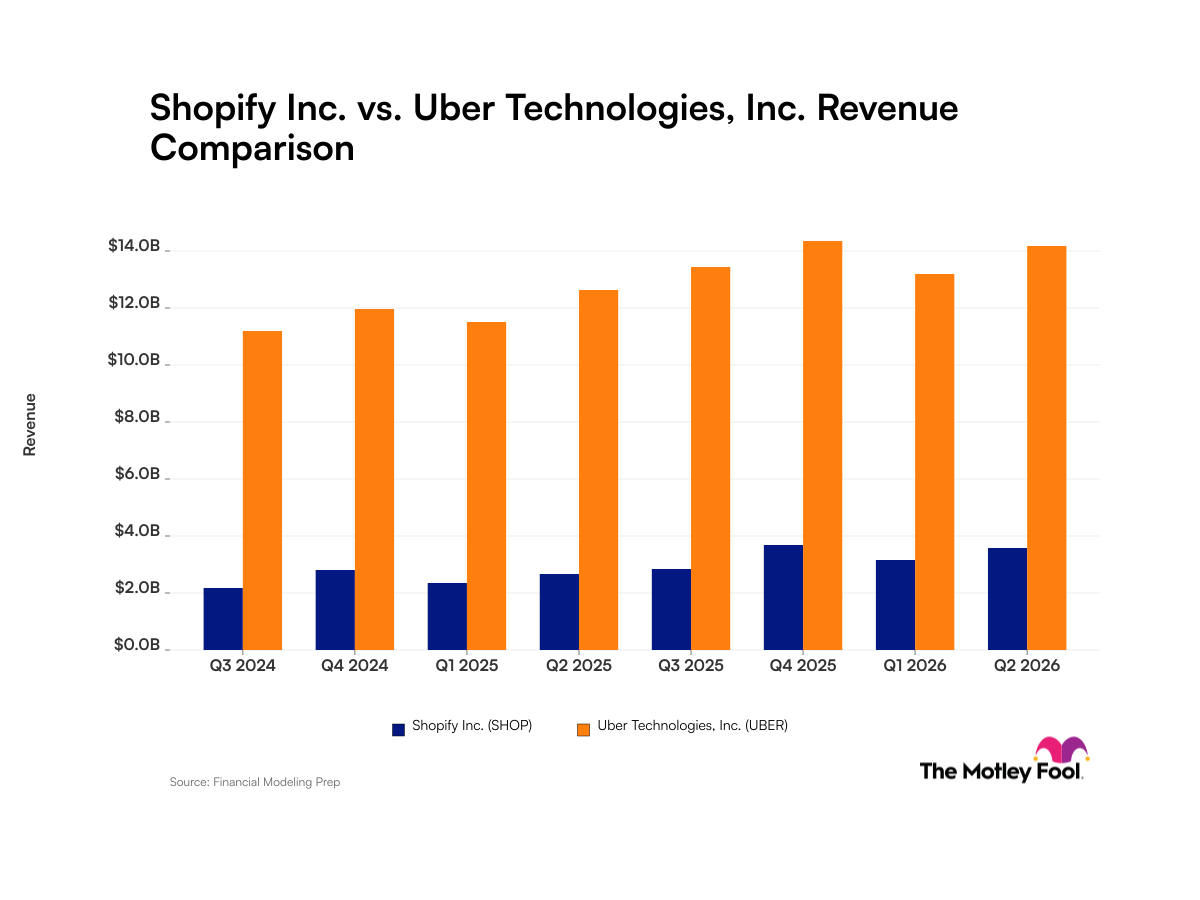
Choosing between Shopify (SHOP +2.70%) and Uber Technologies (UBER -0.58%) requires balancing e-commerce growth with dominance in physical logistics. Both companies have evolved from disruptive start-ups into profitable industry leaders with global reach.
Shopify serves as the engine for online commerce by providing software that helps businesses sell products anywhere. Uber operates a multi-sided platform connecting riders, drivers, and merchants. They represent two different paths toward capturing consumer spending in the digital age.
The case for Shopify
Shopify sells internet infrastructure for commerce, offering a platform that helps businesses of all sizes start and grow their operations. The company generates revenue through subscription solutions and merchant services, including payment processing and shipping. Its ecosystem is bolstered by strategic partnerships with companies like Stripe and PayPal, while the recent acquisition of Tailwind Labs supports its long-term vision for agentic commerce and improved platform interfaces.

NASDAQ: SHOP
Key Data Points
In FY 2025, revenue reached nearly $11.6 billion, representing growth of approximately 30.1% compared to the prior year. This expansion was supported by increased adoption of its merchant services and price adjustments across its subscription tiers. The company reported net income of roughly $1.2 billion for the period, demonstrating its ability to maintain profitability while investing in new technologies like artificial intelligence.
As of its December 2025 balance sheet, the debt-to-equity ratio was 0.0x, meaning the company has no debt relative to its shareholder equity. The current ratio, which measures the ability to cover short-term debts with short-term assets, was approximately 6.0x. Shopify generated free cash flow of nearly $2.0 billion, defined as cash from operations minus capital expenditures. Note that stock-based compensation accounted for roughly 22.1% of operating cash flow, inflating reported cash generation, since SBC is a non-cash expense added back to cash flow. This financial strength is a key reason many investors look toward tech stocks for long-term growth.
The case for Uber Technologies
Uber operates a global technology platform that connects consumers with mobility, delivery, and freight services. The company recently moved to acquire Delivery Hero (DLVHF +0.00%) for nearly $14.8 billion, aiming to expand its footprint in the international delivery market. Uber relies on a massive network of active monthly users and maintains strategic partnerships for autonomous vehicle research with companies such as Waymo.

NYSE: UBER
Key Data Points
In FY 2025, revenue reached approximately $52.0 billion, a 18.3% increase over the previous fiscal year. This growth was driven by higher trip volumes in the mobility segment and steady demand for delivery services. The company posted net income of roughly $10.1 billion, though this figure was significantly influenced by the valuation of its equity investments in other technology companies.
As of the December 2025 balance sheet, the debt-to-equity ratio was nearly 0.4x, which compares total debt to shareholders' equity. The current ratio was approximately 1.1x, indicating the company maintains just enough liquid assets to cover its upcoming liabilities. Uber generated free cash flow of close to $9.8 billion in FY 2025. This strong cash generation allows the company to fund its own growth and pursue large acquisitions without relying heavily on outside financing.
Risk profile comparison
Shopify faces intense competition from large technology platforms and niche service providers that could erode its market share. The company is also exposed to cybersecurity threats and evolving global privacy regulations that may lead to litigation or fines. Furthermore, Shopify relies on third parties like Alphabet (GOOGL +0.35%) for cloud hosting, meaning any disruption in those services could impact its ability to serve merchants.
Uber faces persistent legal challenges regarding whether drivers should be classified as independent contractors or employees. This labor classification risk could fundamentally change the cost structure of the business model. Additionally, Uber competes in dense urban markets against rivals like Lyft (LYFT +0.19%) and DoorDash (DASH +0.96%), where pricing pressure remains high. The company also faces significant financial risks from ongoing litigation related to passenger safety and regulatory compliance.
Valuation comparison
Uber Technologies appears more attractively valued on an earnings basis, while Shopify carries a much higher premium due to its faster growth and software-based business model.
| Metric | Shopify | Uber Technologies |
|---|---|---|
| Forward P/E | 80.5x | 20.3x |
| P/S ratio | 14.8x | 2.5x |
Valuation metrics include those sourced from Financial Modeling Prep (FMP) and may differ from those of other data providers.
Which stock would I buy in 2026?
To compare Shopify and Uber, investors should consider a few key factors. Let's have a look at them and see what that tells us about each stock.
First off, there's growth. While Uber boasts far more revenue than Shopify ($55 billion vs. $13 billion), Shopify is growing its revenue base faster. Over the last three years, Shopify's revenue growth has averaged 28.5%, while Uber's has averaged 16.9%. What's more, Shopify's growth is accelerating, while Uber's is decelerating. Shopify's year-over-year revenue growth reached 33.7% in its most recent quarter, while Uber's dipped to 12.2%. When it comes to growth, Shopify is the clear winner.
Another factor to consider is profitability. Here, both companies have excelled. Over the last ten years, Shopify's operating margin has consistently improved. The company achieved sustained profitability in 2024, and since then, operating margins have steadily climbed, reaching an all-time high of 17.8% in its most recent quarter. Similarly, Uber achieved long-term profitability in 2023, with its operating margin reaching an all-time high of 13.3% in its most recent quarter.
One final factor to weigh is free cash flow. In this case, we should compare free cash flow per share to keep the comparison balanced. In doing so, Uber comes out ahead. The company's free cash flow per share stands at $4.85/share, far ahead of Shopify's $1.79/share. Notably, prior to 2023, Shopify generated more free cash flow per share.
To sum up, Shopify and Uber are both fantastic companies. They exhibit many of the fundamental characteristics investors should want, including solid growth, improving profitability, and ample free cash flow. For me, Shopify is the more compelling stock given its accelerating growth. However, Uber remains a stock worth considering.