Microsoft: Consistent Revenue Climbs
Microsoft (MSFT +1.75%) primarily generates revenue by licensing software, selling computing devices, and providing cloud infrastructure services to businesses and individuals.
It recently expanded data center agreements with several partners, and it reported a 40% net income margin for the quarter ended June 30, 2026.
Apple: Navigating Seasonal Revenue Cycles
Apple (AAPL +0.36%) earns most of its money by conceptualizing and selling consumer electronic devices, alongside an array of subscription services.
It faced regulatory actions in the European Union regarding its digital storefront, while reporting a 27% net income margin for the quarter ended June 27, 2026.
Why Revenue Matters for Retail Investors
Revenue gives investors a top-level view of how much money a business brings in before expenses are deducted. Tracking this figure helps investors understand the total scale and top-line growth trajectory of a company.
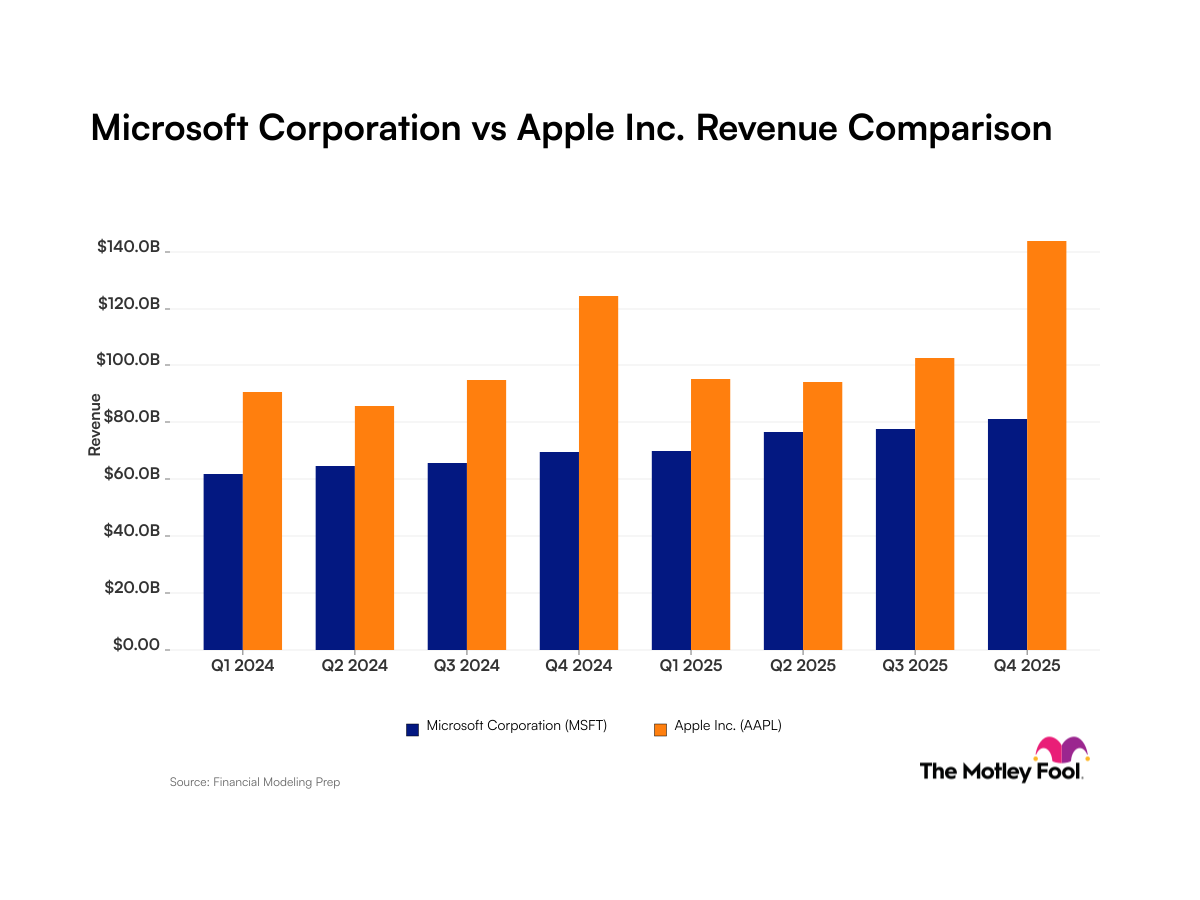
Quarterly Revenue for Microsoft and Apple
| Quarter (Period End) | Microsoft Revenue | Apple Revenue |
|---|---|---|
| Q3 2024 | $65.6 billion (period ended Sept. 2024) | $94.9 billion (period ended Sept. 2024) |
| Q4 2024 | $69.6 billion (period ended Dec. 2024) | $124.3 billion (period ended Dec. 2024) |
| Q1 2025 | $70.1 billion (period ended March 2025) | $95.4 billion (period ended March 2025) |
| Q2 2025 | $76.4 billion (period ended June 2025) | $94.0 billion (period ended June 2025) |
| Q3 2025 | $77.7 billion (period ended Sept. 2025) | $102.5 billion (period ended Sept. 2025) |
| Q4 2025 | $81.3 billion (period ended Dec. 2025) | $143.8 billion (period ended Dec. 2025) |
| Q1 2026 | $82.9 billion (period ended March 2026) | $111.2 billion (period ended March 2026) |
| Q2 2026 | $90.0 billion (period ended June 2026) | $109.4 billion (period ended June 2026) |
Data source: Company filings. Data as of July 31, 2026.
Foolish Take
Apple’s revenue trend shows a sales spike in the fourth quarter, which is the company’s fiscal first quarter. This makes sense given its focus on consumer products and the holiday shopping season.
Microsoft, once a direct competitor of Apple, now produces more of its income from cloud computing than consumer electronics. As a result, it’s experiencing consistent quarter-over-quarter sales growth as demand for its artificial intelligence offerings contribute to this expansion.
In fact, Microsoft stock has soared since reporting results for its fiscal fourth quarter ended June 30. Its $90 billion represented strong 18% year-over-year sales growth. But what propelled its shares upward was an increase in fiscal Q4 diluted earnings per share to $4.81, up from $3.65 in the previous year. This demonstrated that the company can grow profits while investing heavily in AI.
On the other hand, Apple stock crumbled after it reported record revenue of $109.4 billion in its fiscal third quarter ended June 27. The business performance wasn’t the cause of the share price decline, but rather, the company’s assessment that shortages in memory components, caused by the rise of AI, would lead to supply constraints going forward.