Intel: Flat Baseline With a Recent Growth Uptick
Intel (INTC +4.04%) primarily earns revenue by manufacturing advanced computing processors and technological solutions for client devices and data centers.
It recently commenced the complex installation of specialized production tools at a brand-new manufacturing facility in Arizona and concurrently faced a major lawsuit before the U.S. Supreme Court concerning the administrative management of its internal employee retirement investment plans.
Nvidia: Rapid and Unbroken Revenue Expansion Trend
Nvidia (NVDA +2.39%) primarily earns revenue by selling advanced graphics processors and computational networking solutions for high-performance computing operations.
It recently committed $1 billion toward independent scientific research initiatives over a five-year period, while simultaneously expanding its large-scale corporate share repurchase program by an additional $150 billion in total authorization capacity to manage its outstanding equity.
Why Revenue Matters for Investors
Revenue here refers to the data provider's standardized income statement revenue line item, and tracking it over time indicates whether a business is reliably attracting paying customers.

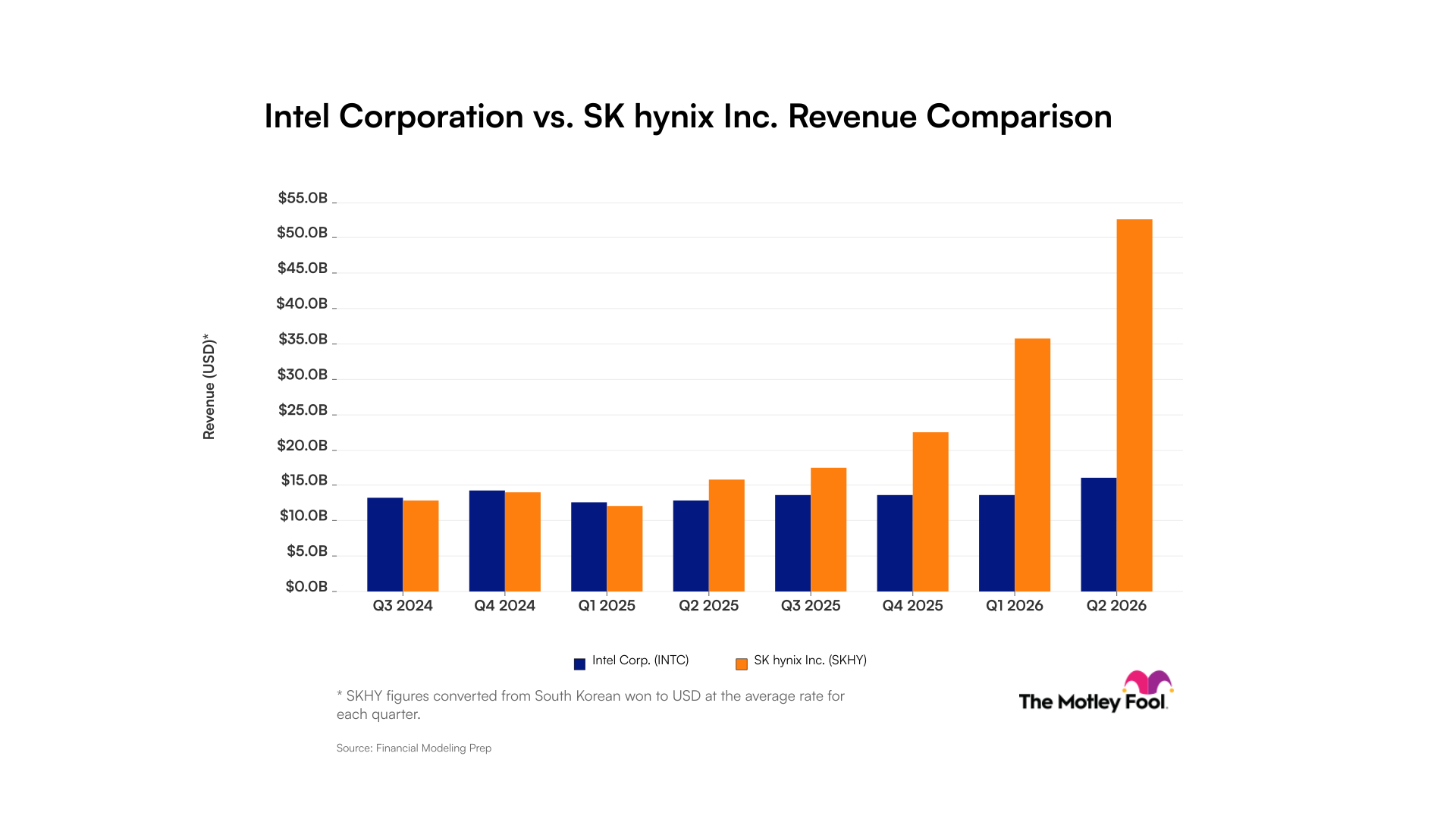
Intel vs. Nvidia Revenue over the last 8 quarters.
Quarterly Revenue for Intel and Nvidia Over Time
| Calendar quarter | Intel Revenue | Nvidia Revenue |
|---|---|---|
| Q3 2024 | $13.3 billion (quarter ended Sept. 28, 2024) | $35.1 billion (quarter ended Oct. 27, 2024) |
| Q4 2024 | $14.3 billion (quarter ended Dec. 28, 2024) | $39.3 billion (quarter ended Jan. 26, 2025) |
| Q1 2025 | $12.7 billion (quarter ended March 29, 2025) | $44.1 billion (quarter ended April 27, 2025) |
| Q2 2025 | $12.9 billion (quarter ended June 28, 2025) | $46.7 billion (quarter ended July 27, 2025) |
| Q3 2025 | $13.7 billion (quarter ended Sept. 27, 2025) | $57.0 billion (quarter ended Oct. 26, 2025) |
| Q4 2025 | $13.7 billion (quarter ended Dec. 27, 2025) | $68.1 billion (quarter ended Jan. 25, 2026) |
| Q1 2026 | $13.6 billion (quarter ended March 28, 2026) | $81.6 billion (quarter ended April 26, 2026) |
| Q2 2026 | $16.1 billion (quarter ended June 27, 2026) | $96.2 billion (quarter ended July 26, 2026) |
Foolish Take
On the surface, investors should probably favor Nvidia's continued growth over Intel's recent revenue struggles, even if Intel is finally breaking out of its revenue range.
Nvidia continues to lead in AI accelerators. This has driven its growth, with revenue rising 106% year over year in the most recent quarter. Intel lags far behind that, growing revenue by a more muted 25% in its latest quarter.
NVDA & INTC: Performance Comparison
Key Financial Metrics


However, amid Intel’s improvement, investors might be more tempted to shift toward that company. Success with its 18A manufacturing process and an improving outlook for its foundry business could indicate that its revenue growth struggles may finally be ending.
Moreover, regarding the companies Nvidia owns, it faces charges of circular financing, the type of financing of its customers that contributed to the decline of Nortel and Lucent during the dot-com bust in the early 2000s.
Despite those situations, Intel's success may be priced in, as it trades at 59 times forward earnings. In contrast, Nvidia's forward P/E is just 23. The financing concerns may play into that relatively low earnings multiple, but it still shows Nvidia offering much faster growth for a significantly lower valuation.
To be sure, investors need to watch the changes in revenue growth trends closely in both chip stocks. If Intel’s comeback continues and the circular financing concerns with Nvidia start to become reality, investors need to revisit this comparison.
Nonetheless, unless and until such fears materialize, investors should probably continue to favor Nvidia’s faster growth.