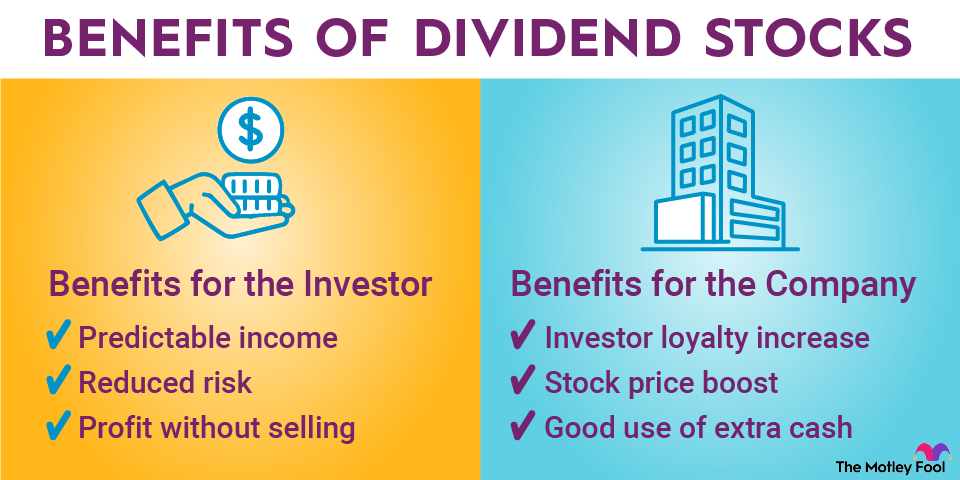
For investors who want their portfolio to work for them, income stocks are one of the most reliable tools available. These are stocks that pay regular dividends, giving you a steady stream of cash simply for holding shares. You can use that income to cover expenses, reinvest it to compound your returns over time, or both.
Income stocks also tend to be less volatile than growth stocks, making them a stabilizing force in almost any portfolio. Here is what to know about income stocks and our top picks to consider.
What are income stocks?
An income stock is any stock that pays a relatively reliable dividend, a regular cash distribution drawn from company profits. Most companies pay dividends quarterly, though some pay annually, semi-annually, or monthly. The return you earn is expressed as a dividend yield, calculated by dividing the annual dividend payment by the share price. A stock paying $1 annually and trading at $20 has a 5% dividend yield.
The best income stocks do more than just pay a dividend. They grow it consistently over time. A company increasing its dividend by 10% annually doubles its payout in just over seven years, and rising dividends tend to push share prices higher as well, giving income investors both passive cash flow and capital appreciation.
Top income stocks to consider
| Name and ticker | Market cap | Dividend yield | Industry |
|---|---|---|---|
| PepsiCo (NASDAQ:PEP) | $217.1 billion | 3.58% | Beverages |
| Verizon Communications (NYSE:VZ) | $213.5 billion | 5.40% | Diversified Telecommunication Services |
| Realty Income (NYSE:O) | $60.6 billion | 4.97% | Retail REITs |
| Johnson & Johnson (NYSE:JNJ) | $583.3 billion | 2.15% | Pharmaceuticals |
| NextEra Energy (NYSE:NEE) | $191.1 billion | 2.53% | Electric Utilities |
1. PepsiCo

NASDAQ: PEP
Key Data Points
PepsiCo pays a well-above-average dividend. The beverage and snacking giant's dividend yield was around 3.5% in early 2026, nearly triple the S&P 500's dividend yield of less than 1.2%.
PepsiCo also has a terrific record of increasing its dividend. The company delivered its 54th consecutive annual dividend increase in early 2026. That kept it in the elite group of Dividend Kings, companies with 50 or more years of consecutive dividend increases.
The snacking and beverage behemoth should have no trouble continuing to provide investors with a rising stream of dividend income. The company's long-term goal is to grow its earnings per share at a high single-digit annual rate. With its earnings on the rise and a strong balance sheet, PepsiCo should have plenty of pop to continue pushing its payout higher.
2. Verizon

NYSE: VZ
Key Data Points
Verizon Communications' (VZ -0.10%) mobile and broadband customers provide a reliable base of revenue and cash flow. Verizon expects to generate over $21.5 billion of free cash flow after funding capital expenditures in 2026. That's a 7% increase from 2025's level and will easily cover its expected annual dividend outlay of around $11.5 billion.
Verizon's shares offered a hefty dividend yield of approaching 6% in early 2026. The telecom giant has also increased its dividend for 19 straight years, the longest current streak in the U.S. telecom sector. Its attractive and growing income stream makes Verizon a great stock for earning passive income.
3. Johnson & Johnson

NYSE: JNJ
Key Data Points
Healthcare behemoth Johnson & Johnson (JNJ -0.39%) pays a very healthy dividend. It offered a dividend yield of more than 2% in early 2026, almost double the S&P 500's level. Meanwhile, it has 63 straight years of dividend increases.
The healthcare company is a financial fortress. It had an elite AAA bond rating (higher than the U.S. government). Johnson & Johnson ended 2025 with $20 billion in cash and $48 billion in debt. Meanwhile, it generated $20 billion in free cash flow in 2025 (more than enough to cover its $12.4 billion dividend payout).
Johnson & Johnson expects to grow its operational sales at a 5%-7% annual rate through 2030, driven in part by a target to grow oncology sales to $50 billion by that year. Meanwhile, its strong balance sheet will give it the flexibility to make acquisitions to further boost its growth (it bought Intra-Cellular Therapies for $14.6 billion and Halda Therapeutics for $3.1 billion in 2025). These factors put it in a strong position to continue increasing its dividend.
4. Realty Income

NYSE: O
Key Data Points
Realty Income (O +0.35%) has been a dependable income stock over the years. The real estate investment trust (REIT) delivered its 113th consecutive quarter of dividend increases in early 2026 and has boosted its payout 133 times since its initial public offering (IPO) in 1994. It has delivered more than 30 years of dividend growth, placing it in the elite Dividend Aristocrats® category. (The term Dividend Aristocrats® is a registered trademark of Standard & Poor's Financial Services LLC.)
The REIT focuses on buying essential retail properties (think home improvement, grocery, and convenience stores), industrial real estate, and other properties (data centers and gaming). It triple-net leases (NNN) the freestanding properties to high-quality tenants, making them responsible for building insurance, maintenance, and real estate taxes and providing Realty Income with very stable income.
It steadily buys new income-producing properties, which should allow the trust to continue increasing its attractive monthly dividend. Realty Income yielded around 5% in early 2026.
5. NextEra Energy

NYSE: NEE
Key Data Points
NextEra Energy (NEE +0.08%) has an excellent income track record. The utility is also a Dividend Aristocrat®, with 30 years of consistent dividend growth. Over the past two decades, NextEra has increased its dividend at a 10% annualized rate.
It's one of the leaders in producing renewable energy and has an extensive backlog of development projects. Combine that growth with the stability of its utility operations, and NextEra should have plenty of power to keep expanding its earnings and dividend in the future. The company expects to increase its payout (which yielded around 3.5% in early 2026) by around 10% in 2026 and by 6% annually in 2027 and 2028.
Income stocks vs. value stocks vs. growth stocks
Income, value, and growth stocks are different categories of stocks based on what they offer investors. Here are some key characteristics of each group and what type of investors might be more interested in the different categories:
- Income stocks: An income stock is any company that pays a higher-yielding dividend that investors would purchase to produce passive income. Some companies tend to lean more towards income generation due to their stable cash flows and slower growth profiles. For example, many pipeline stocks, REITs, and utilities tend to be good income stocks. Income stocks are ideal investments for retirees or those seeking lower-risk investments.
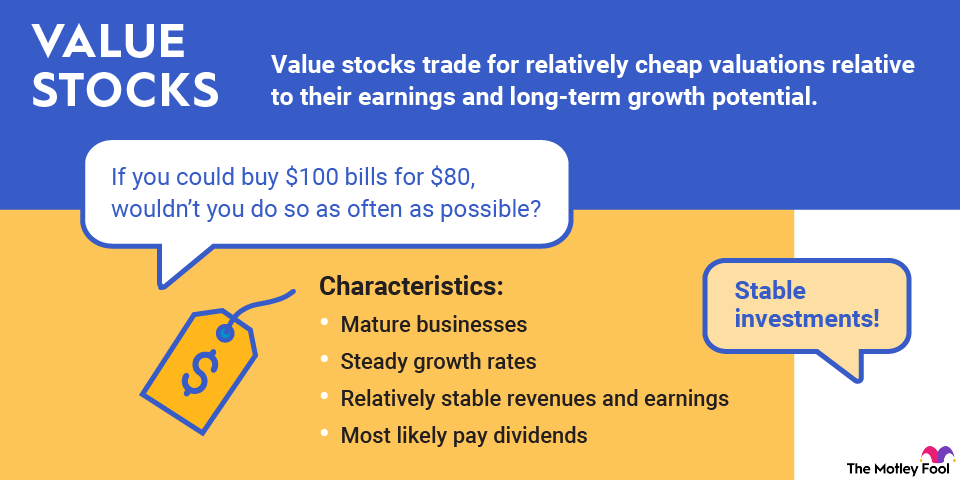
- Value stocks: Value stocks are companies that trade at lower valuations compared to the broader market, their closest peers, or their historical average. Value stocks often trade at a lower valuation for a reason. They've encountered financial difficulties, their growth rate has slowed, they're facing increased competition, or the market has sold off. Investors such as Warren Buffett prefer to invest in value stocks because they believe they can earn attractive returns by paying a reasonable price for a quality company. Many value stocks pay dividends, which can also make them attractive income stocks.
- Growth stocks: Growth stocks are companies growing their revenue at above-average rates. They tend to be earlier-stage companies or those capitalizing on a major growth trend, such as cloud computing or artificial intelligence (AI). Many growth stocks trade at higher valuations and often don't pay dividends or have very low yields. Growth stocks are ideal for younger investors or those seeking above-average returns.
How to create an income investing strategy
The goal of an income investing strategy is to build a diversified portfolio of dividend-paying stocks that generates enough reliable cash flow to meet your needs. Spreading investments across multiple companies and industries reduces the impact of any single company cutting or suspending its dividend.
Beyond individual stocks, dividend-focused mutual funds and ETFs can provide broad exposure to income-generating companies in a single investment. Income stocks tend to be most common in real estate, energy, financials, and consumer staples, so these sectors are natural starting points for building a portfolio.
How to invest in stocks
Here's a step-by-step guide on how to add income stocks to your investment portfolio:
- Open your brokerage app: Log in to your brokerage account where you handle your investments.
- Search for the income stock: Enter the ticker or company name into the search bar to bring up the stock's trading page.
- Decide how many shares to buy: Consider your investment goals and how much of your portfolio you want to allocate to this stock.
- Select order type: Choose between a market order to buy at the current price or a limit order to specify the maximum price you're willing to pay.
- Submit your order: Confirm the details and submit your buy order.
- Review your purchase: Check your portfolio to ensure your order was filled as expected and adjust your investment strategy accordingly.
Related investing topics
FAQ
Income stocks FAQ
About the Author