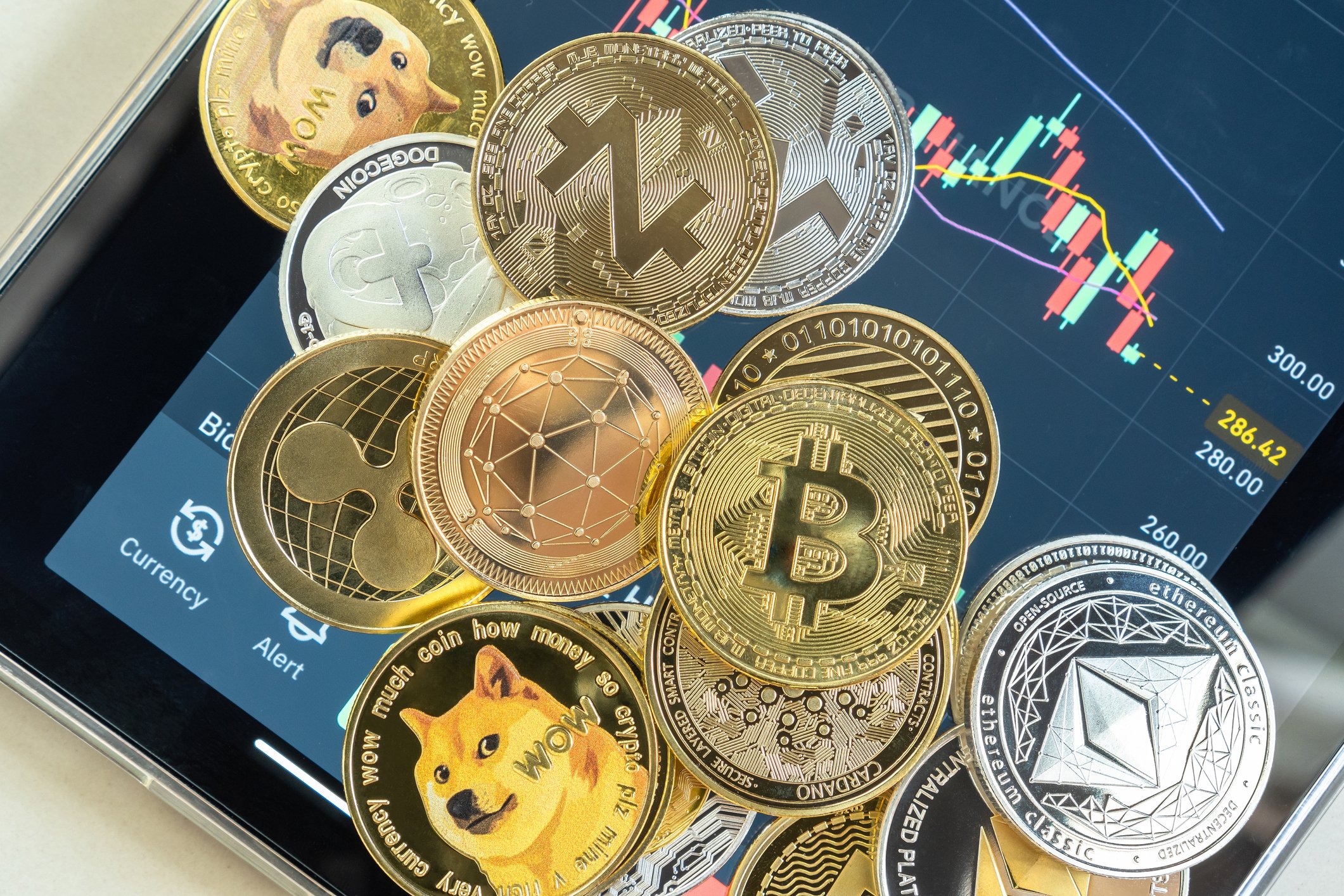
The total value of all cryptocurrencies in circulation peaked at $4.4 trillion in October last year, but it has since plummeted to just $2.4 trillion. The industry faces a lot of uncertainty amid sluggish adoption rates even for some of the largest coins and tokens, but investors are also trimming their exposure to risky assets right now with economic uncertainty on the rise.
Every major cryptocurrency is down from its peak -- even Bitcoin, which has declined by 43%. But the smaller end of the market is bearing the brunt of the losses, with speculative meme coins Shiba Inu (SHIB +0.61%) and Dogecoin (DOGE +2.75%) each plummeting by almost 70% from their 52-week highs.
Here's why I predict both meme coins will sink by a further 50% (or more) from their current levels over the long term.

Image source: Getty Images.
Shiba Inu's relevance continues to fade
Shiba Inu was created in 2020 by an anonymous developer who saw the incredible rise in Dogecoin's value and wanted to launch an alternative that could offer faster, lower-cost transactions. It was built on the Ethereum platform, so it leans on one of the largest, most liquid, and most secure crypto networks in the world, which gives the token legitimacy.
Shiba Inu delivered a return of 45,278,000% in 2021, which would have been enough to turn a perfectly timed investment of just $3 into over $1 million. But the incredible rally was driven entirely by speculation, so it inevitably ran out of steam. As I mentioned earlier, the token is down almost 70% from its 52-week high, but it's also down 93% from its 2021 peak.
In order for a cryptocurrency to deliver sustainable upside, it needs a consistent source of demand. This demand can come from consumers who use it to buy products and services, or it can come from investors who believe the coin or token is a legitimate store of value. Unfortunately, Shiba Inu hasn't had much luck in the first category, and I doubt you could find any investors who think it's a good store of value given its sharp decline.

CRYPTO: SHIB
Key Data Points
According to the crypto directory Cryptwerk, just 1,144 businesses worldwide are willing to accept Shiba Inu as payment. This slow adoption is understandable because the token's extreme volatility would make cash-flow management practically impossible. However, consumers have no reason to own a token if they can't spend it at their favorite stores, so it's unlikely to ever be a widely adopted currency.
In 2023, developers launched a Layer-2 blockchain solution called Shibarium to address some of the inefficiencies in the Ethereum network, in the hope that this would encourage more use. It made transactions faster and cheaper than ever before, but unfortunately, it hasn't moved the needle at all in terms of adoption.
Without a sustainable source of demand, further downside will be the path of least resistance for Shiba Inu, which is why I predict it will lose 50% of its current value in the long run.
Dogecoin has a glaring supply problem
Dogecoin was created in 2013 by two friends who felt the cryptocurrency industry was taking itself too seriously. At the time, Bitcoin was quickly rising in popularity, and it attracted hordes of investors who believed cryptocurrencies were about to transform the entire financial system. The two friends wanted to lighten the mood, and they openly admitted they devised Dogecoin as a joke.
However, investors latched on to the coin when prominent figures like Tesla CEO Elon Musk started talking about it in 2019. Musk didn't necessarily endorse it for any particular uses, but it seemed he found the project amusing because he regularly shared funny Dogecoin-themed memes on social media and participated in friendly banter with other enthusiasts.
By 2021, the digital coin had amassed a market capitalization of over $90 billion. Not only did it become one of the biggest cryptocurrencies in the world, but it was also suddenly more valuable than most companies in the S&P 500. But as was the case with Shiba Inu's blistering rally, Dogecoin's upside was also largely fueled by speculation.

CRYPTO: DOGE
Key Data Points
As a result, Dogecoin is now down 87% from its 2021 peak, and there's a key issue that will weigh on its value over the long term: supply. New Dogecoin units are constantly entering circulation through a process called mining, which is when validators verify transactions and add new blocks to the blockchain. Mining involves using computers to solve complex mathematical equations, which costs money, so these validators are paid rewards in the form of Dogecoin coins.
Only 5 billion coins can be mined each year, but with 153.7 billion coins currently in circulation, that means supply will roughly double over the next three decades. Therefore, the value of each coin needs to halve over the same period in order for Dogecoin to maintain a constant market cap, unless it finds a sustainable source of demand capable of driving real value. Given that the coin's main use case is "Elon Musk posted a meme," that's a tough hill to climb.
Unfortunately, like Shiba Inu, Dogecoin has struggled to convince consumers and businesses that it's a viable payment mechanism, and it certainly isn't a good store of value.