In the artificial intelligence (AI) computing world, there are few stocks more popular than AMD (AMD +0.73%) and Nvidia (NVDA +0.36%). These two are the primary compute providers for AI and are going head-to-head for GPU supremacy.
In the early innings of the AI arms race, Nvidia stormed out to an enormous lead, but AMD has also been a solid performer. Since 2023, Nvidia's stock is up 1,120%, while AMD's is up a respectable 242%.
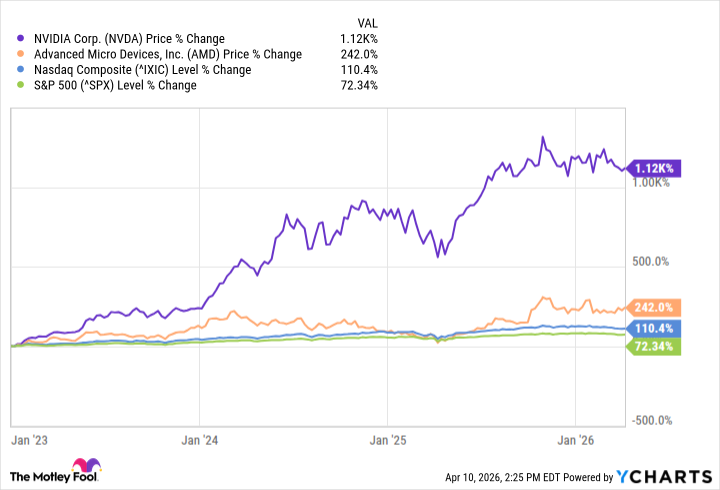
However, AMD has been the much better stock to own over the past year, rising 165% versus Nvidia's 82%. But which one is the better buy now?
Image source: The Motley Fool.
Nvidia's data center business is far larger than AMD's
Although the two companies are competing against each other for computing share in data centers, the companies are fundamentally different. Nvidia is built completely around its GPU ecosystem, which has allowed it to push the limits of what's possible with traditional computing. While Nvidia has other products, the sole purpose of these products is to elevate the GPU ecosystem.

NASDAQ: NVDA
Key Data Points
AMD has a much wider product lineup. While it has GPUs (graphsics processing units) for data centers and gaming, as Nvidia does, it also has a large CPU (central processing unit) component and is more heavily involved in consumer products than Nvidia. Additionally, AMD owns Xilinx, which is an embedded-processor business that makes industry-specific chips.
While AMD's concentration can be a good thing if the AI market falls apart, right now, it's holding it back.
During Nvidia's most recent quarter, it generated $68.2 billion in revenue, up 73% year over year. Its data center division, which encompasses its AI-focused business, generated $62.3 billion in revenue, up 75% year over year. Companywide, in its most recent quarter, AMD generated $10.3 billion in revenue, up 34% year over year. Its data center division produced $5.4 billion in revenue, up 39% year over year.
Clearly, Nvidia's business is seeing a lot more success, and its data center division is over 10 times the size of AMD's.
AMD pundits will say that its lack of data center business makes it more stable in case the AI market tanks, but AMD is looking to change the makeup of its business as well.

NASDAQ: AMD
Key Data Points
At the end of 2025, AMD's management laid out a five-year growth trajectory that targets a 35% compounded annual growth rate (CAGR) for revenue over the next five years, which would be a successful investment by most investors' standards.
However, they expect AMD's embedded and client and gaming divisions to grow at a 10% CAGR, while their data center division increases at a 60% CAGR. If this projection pans out, AMD will look a lot like Nvidia at the end of it, which eliminates this potential advantage of investing in AMD's stock.
There's also another drawback for AMD as well.
Nvidia's stock is far cheaper
Despite being more successful and growing at a faster pace, Nvidia's stock is far cheaper than AMD's. Due to each company's strong growth rate, the best way to value these stocks is by utilizing the forward price-to-earnings ratio, which uses estimated earnings. From this standpoint, you have to pay over a 50% premium to own AMD shares versus Nvidia's.
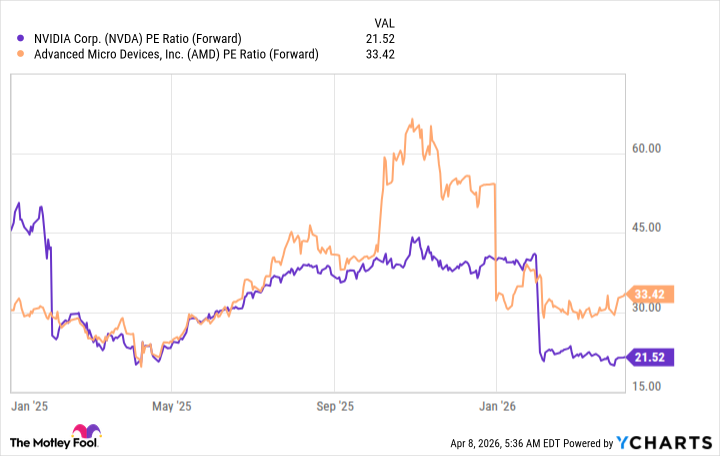
NVDA PE Ratio (Forward) data by YCharts
That's completely backward from what logic says it should be, which is why I think Nvidia is the far better buy here.
It's not often you get to buy the industry leader that's growing at double the pace of the competition at a discount, but that's exactly what the market is presenting to investors. This mismatch may not stay active for long, and investors might want to hop on the opportunity while it's still available. AMD isn't a bad investment, but it's just not quite as good as Nvidia.