Don't look now, but the S&P 500 index is becoming something of a desert for income investors. As reported recently by Yahoo! Finance, the average dividend yield of all 500 titles has shriveled to barely over 1.2%, one of its lowest levels in more than 50 years.
Now that, of course, hardly means that all dividend-paying companies in that grouping dispense at discouragingly skinny rates. Here are three S&P 500 index mainstays that boast yields well higher than the average: Take a bow, AbbVie (ABBV 0.29%), Procter & Gamble (PG +2.67%), and Coca-Cola (KO +0.74%).
Image source: Getty Images.
1. AbbVie -- current yield: 3.3%
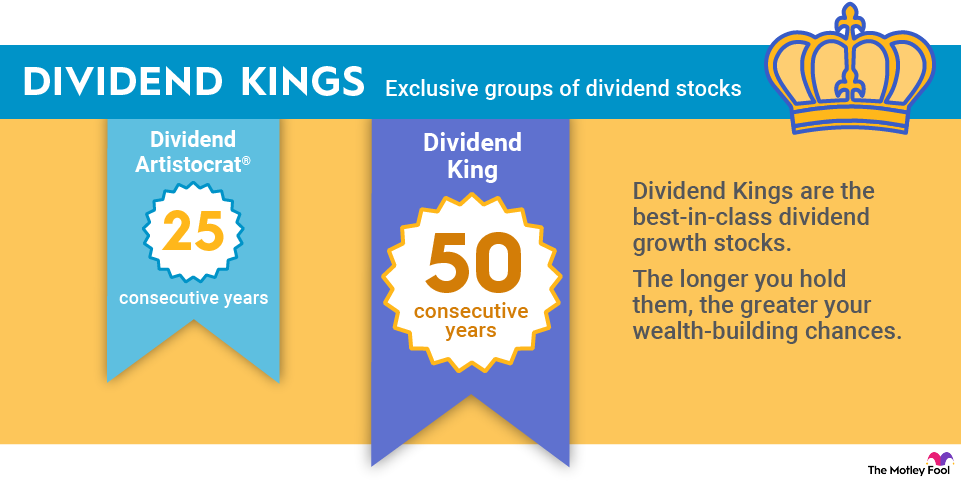
I should also mention that all three are Dividend Kings, the name given to the very exclusive club of stocks that have enacted dividend raises once annually for a minimum of 50 years running. AbbVie qualifies by virtue of its 2013 spinoff from Abbott Laboratories; together, their hikes stretch back 54 years.
A relatively high dividend yield can indicate share price weakness, and to a degree, that's the dynamic with AbbVie -- the stock is down by more than 7% this year.
In March, the U.S. Food and Drug Administration approved rival Johnson & Johnson's immunology drug Icotyde, seemingly a threat to AbbVie's blockbuster Skyrizi. Although Icotyde has been greenlit for only one condition, plaque psoriasis, in contrast to Skyrizi's four, it's a pill rather than a jab.
This convenience, plus Johnson & Johnson's push to develop the drug for more indications, has raised investor fears of a potential Skyrizi killer.
But I think Skyrizi will remain strong for a while. After all, it usually takes some time to collect approvals for multiple indications. Also, in terms of convenience, Skyrizi's once-every-12-weeks regimen might be preferable to Icotyde's regimen, as the latter must be taken daily.
Meanwhile, AbbVie has a formidable commercial portfolio even without its top drug. It's got a clutch of other blockbusters across several therapeutic areas, such as antipsychotic treatment Vraylar. As for the company's pipeline, it's wide, deep, and has admirable potential.
For my money, this is one of the best pharmaceutical stocks on the scene, and management will surely cope with the challenges it faces. I'd buy this one.

NYSE: ABBV
Key Data Points
3. Procter & Gamble -- current yield: 2.9%
A vast number of the household products we regularly use are sold by Procter & Gamble. Among the company's many brands are Gillette razors, Cascade dishwasher detergent, Old Spice cologne, and a platoon of other instantly recognizable goods.
With that, Procter & Gamble is an inescapable presence in supermarkets, grocery outlets, and convenience stores throughout the world, and especially in the United States. That shakes out to a constant, gushing torrent of net sales that totaled a dizzying $84.3 billion in 2025.
More importantly for income investors, the company is a cash-generating machine. Annual free cash flow ranged from almost $13.6 billion to over $16.5 billion across the past half-decade, more than enough to pay for a year's worth of dividends.
With its scope and ubiquity, Procter & Gamble has great power with retailers, not to mention consumers. It's famous for its occasional, once-per-year price rises, a lever it can pull when economic conditions or higher expenses warrant such a move.
The company is many things, but what it's not is a fast-growing dynamo. It's big, slow, and steady in terms of growth, but then again, few own the stock in hopes of monster pops in the fundamentals. Instead, they're buying into a company that pays a seemingly ever-rising, relatively generous dividend that is a backbone of the American consumer economy.
I don't think anyone's going to go broke owning Procter & Gamble stock. In fact, I'd go as far as to say it's one of the most dependable income stocks available today. To me, it's a model of the set-it-and-forget-it, keep-pocketing-the-dividends approach to investing.

NYSE: PG
Key Data Points
3. Coca-Cola -- current yield: 2.7%
Finally, we have S&P 500 index dividend outlier Coca-Cola, a company anchored by a product that needs no introduction. What the company might require for some, however, is a brief glance at its beverage portfolio, as many are unaware of how truly extensive and deep it is.
Coca-Cola not only slings its namesake drink and Coke's lemon-lime cousin Sprite, but it also has a commanding presence in segments such as juice (it owns Minute Maid), iced tea (Gold Peak), water (Dasani), and even java (Costa Coffee). And that's just the tip of a very large iceberg. Whatever nonalcoholic beverage you like to quaff, Coca-Cola probably makes it.
The company has many leading products in its various categories. Therefore, like Procter & Gamble, it's a constant presence in the convenience store and everyone's local supermarket. The result? A similar revenue gush and mountains of free cash flow, thanks to products that are famous, well-liked, relatively cheap to make, and require little or no innovation.
This also means reliably high profits compared to revenue. Since 2021, its net margins have landed reliably above 20% every year.
So it's little wonder Coca-Cola is such an eager and reliable dividend raiser. In February, it maintained its Dividend King crown with its 64th consecutive annual dividend raise. Mirroring the usual growth the company posts in both revenue and net income not under generally accepted accounting principles (GAAP), it raised its quarterly payout by 4% to $0.51 per share.
I've done plenty of traveling across this globe in my years, and I can't remember any populated locale that didn't have at least a few Coca-Cola signs displayed in its stores or company products for sale. I doubt the situation will change much, if at all, so I think the company will continue to be a highly profitable beast that generates plenty of cash and remunerates its shareholders very generously.