Procter & Gamble (PG 0.29%) just announced its 70th consecutive annual dividend raise, boosting its quarterly payout from $1.0568 per share to $1.0885 per share, or $4.354 per year -- good for a forward yield of 3% based on the share price at the time of this writing.
The dividend increase makes P&G one of the longest-tenured Dividend Kings, which are companies that have increased their payouts for at least 50 consecutive years. There are 57 Dividend Kings -- but only five of them have increased their dividends for at least 70 consecutive years.
Here's why P&G is a top dividend-paying value stock to buy now.
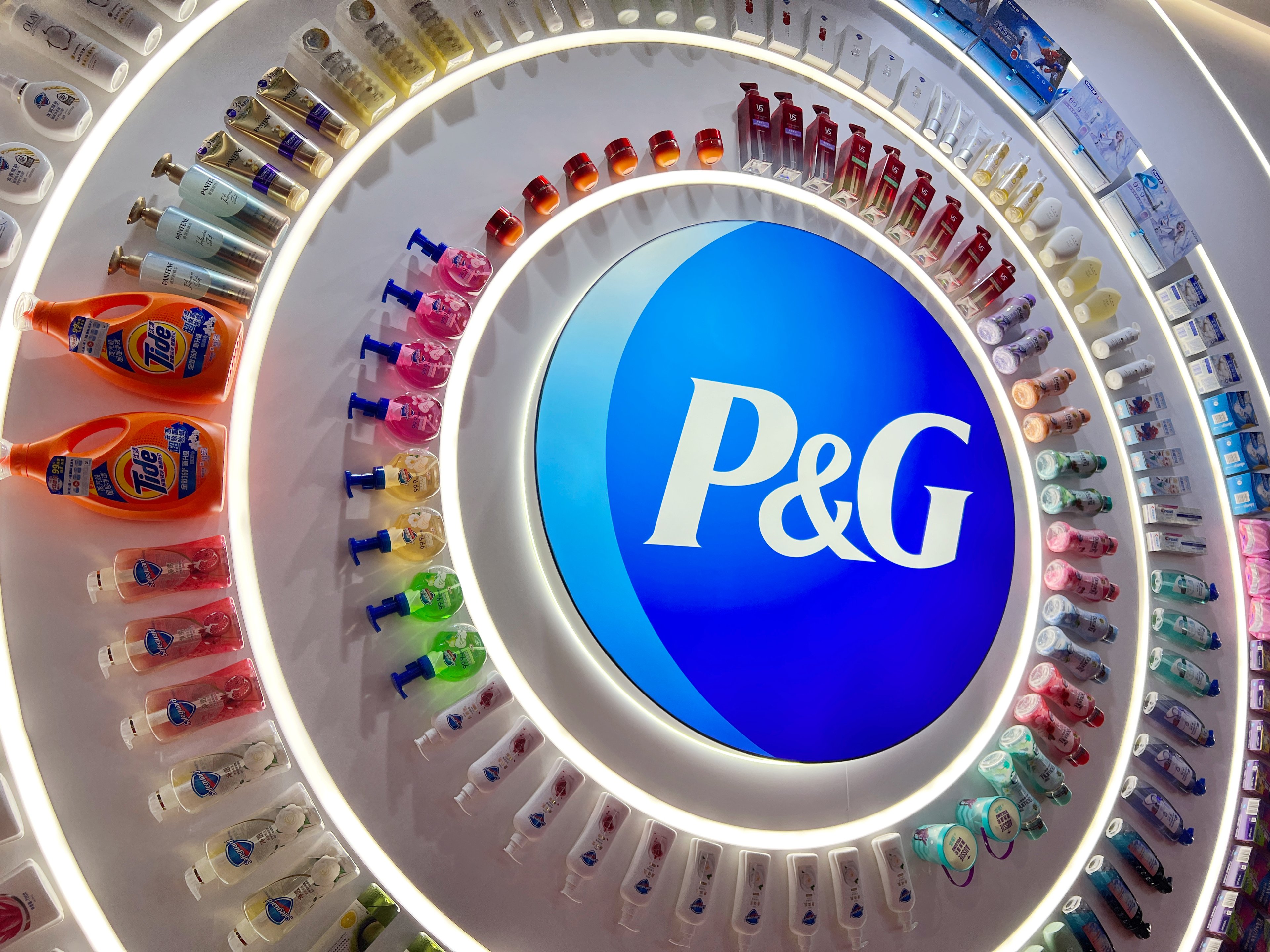
Image source: Getty Images.
P&G is in a league of its own
Procter & Gamble is the largest household and personal products company in the world and the third-largest U.S. consumer staples company by market cap -- behind Walmart and Costco Wholesale, but ahead of Coca-Cola.
P&G has a portfolio of leading brands across everyday-use categories spanning:
- Diapers (led by Pampers)
- Paper towels (Bounty)
- Toilet paper (Charmin)
- Tissues (Puffs)
- Feminine products (led by Always)
- Grooming and hair care (Gillette, Old Spice, Pantene, and Head & Shoulders, among others)
- Cleaning products (Dawn, Cascade, Febreze, etc.)
- Laundry detergents (Tide, Gain, and others)
- Oral and personal healthcare products (Crest, Oral-B, Vicks, etc.)
- Skin and personal care (Olay, SK-II, etc.)
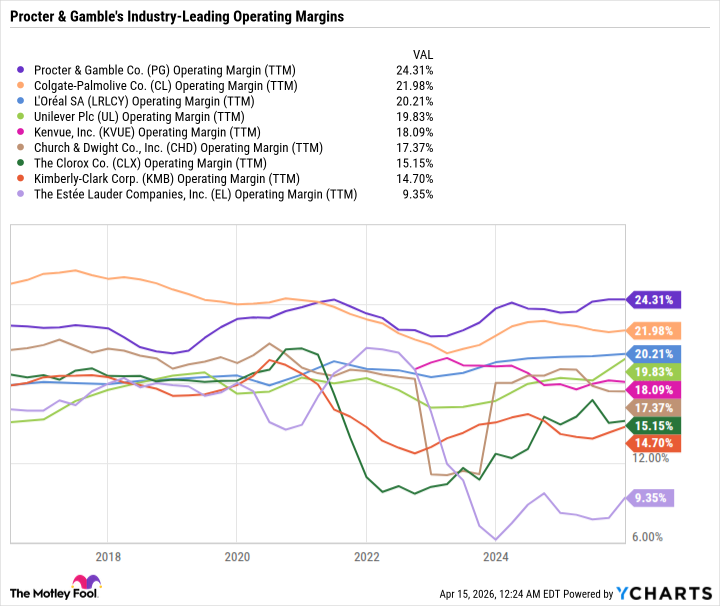
P&G's international brand recognition, elite supply chain and marketing, and sheer size across categories give it impeccable pricing power and negotiating leverage with retailers. These advantages allow P&G to consistently generate operating margins above 20% -- often ahead of its peers.
PG Operating Margin (TTM) data by YCharts
Despite its competitive advantages, P&G's growth slowed in recent years due to consumer spending challenges driven by higher living costs and inflationary pressures, including higher everyday expenses and now elevated oil prices. P&G is generally considered a recession-proof business because demand for its products remains consistent across economic cycles. But consumers can change their behavior when budgets are strained and may opt to buy a private-label brand like Costco's Kirkland Signature diapers, for example, instead of Pampers to stretch their dollars.

NYSE: PG
Key Data Points
A measured dividend increase
Given the state of P&G's business and the slowdown in the broader household and personal products industry, it's unsurprising that P&G's latest dividend raise was just a 3% increase. Historically, it's far more common to see P&G raise its dividend by mid-to-high single digits. But it's not unheard of for P&G to announce a low-single-digit raise.
The most recent example was 2023, when P&G coincidentally also raised its dividend by just 3%. This made sense at the time, given that P&G was coming off years of price increases and inflationary pressures were on the rise post-pandemic.
Maintaining a 70-year streak of dividend increases means P&G has to consistently grow its earnings and avoid outsized raises during particularly good years, because the last thing P&G wants is for the dividend expense to get so large that it gobbles up all its free cash flow (FCF).
P&G's dividend expense is still at a healthy level. Its trailing-12-month earnings per share of $6.75 and $6.09 in FCF per share easily cover its dividend, even after the latest raise. And the payout ratio of 61.9% is rock solid for a consumer staples company.
P&G is a uniquely flexible conglomerate
Aside from high margins, earnings, and FCF, what makes P&G such an elite dividend stock is its ability to take what the market gives it by leaning into whatever product categories and geographic regions are doing well.
For example, in P&G's latest quarter, which was the second quarter of fiscal 2026, Latin America and Europe helped offset weak performance in North America. Hair care was P&G's best category, and skin and personal care, personal healthcare, home care, and oral care also helped pick up the slack from weak performances in grooming, fabric care, baby care, feminine care, and daily care.
P&G doesn't rely too heavily on any particular region or product category. And even within specific categories, it can retain a customer sale even during spending pullbacks. For example, a customer may pivot from Tide to a generally less expensive detergent brand like Gain to cut costs, or from Pampers to Luvs. But P&G still lands the sale because it owns both the premium-priced category option and a more budget-friendly choice.
A top stock to buy and hold
P&G is one of the most reliable dividend stocks for value investors to buy and hold. But P&G rarely trades at a discount to the S&P 500 (^GSPC +0.79%), given its quality.
Now is an incredible opportunity for investors to buy P&G on sale. The sell-off in the stock has pushed its yield to around a five-year high and the valuation down to a five-year low. P&G sports a price-to-earnings (P/E) ratio of just 21.4 and a forward P/E of 20.8 compared to 20.3 for the S&P 500.
Add it all up, and P&G checks all the boxes of a dividend stock that can anchor a passive income portfolio.