Micron Technology (MU +4.80%) stock has been on a stellar run over the past year, rising an incredible 522% as it has benefited big time from the fast-growing demand for memory chips used in artificial intelligence (AI) data centers.
The phenomenal demand for AI chips has been exceeding supply, and the good news for suppliers is that the shortage isn't expected to end anytime soon. But are Micron's catalysts sustainable for the next five years, enabling the AI stock to deliver more gains to investors through the end of the decade?

Image source: Micron Technology
Booming memory chip demand should ensure fantastic growth
Memory is a key component of AI accelerator chips used in data centers to handle diverse workloads. Micron manufactures both dynamic random-access memory (DRAM) chips -- which enable AI processors to quickly access large datasets -- and NAND flash memory, which is used to store data for model training and inference applications.

NASDAQ: MU
Key Data Points
The increasing complexity of AI workloads has created the need for more data processing, which explains why AI data centers have been gobbling up both DRAM and NAND flash chips at an incredible pace. According to one estimate, data centers are expected to consume 70% of global memory production this year, leaving a significant supply gap for other applications such as smartphones and personal computers (PCs).
Micron peer SK Hynix predicts that memory wafer supply will be 20% below demand through 2030. That's despite the efforts to bring additional manufacturing capacity online, as deploying new plants takes time. Moreover, the new capacity set to be added over the next five years is likely to sell out quickly due to pent-up demand from smartphones and PCs.
So, the memory industry is poised for healthy growth over the next five years. This is great news for Micron stock, as the red-hot growth the company has experienced over the past couple of years seems sustainable.
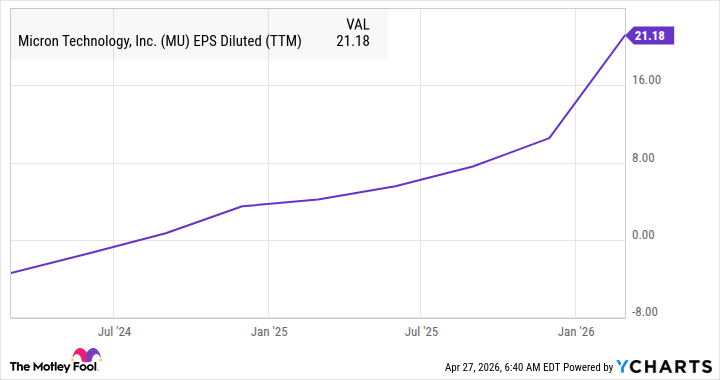
MU EPS Diluted (TTM) data by YCharts
Here's how much upside investors can expect from the stock by 2030
Micron's earnings growth has simply taken off, as shown in the chart above. As memory demand is poised to continue outpacing supply through 2030, there is a solid chance that the favorable memory pricing environment will persist. That explains why analysts are forecasting Micron's earnings to increase at a healthy rate.
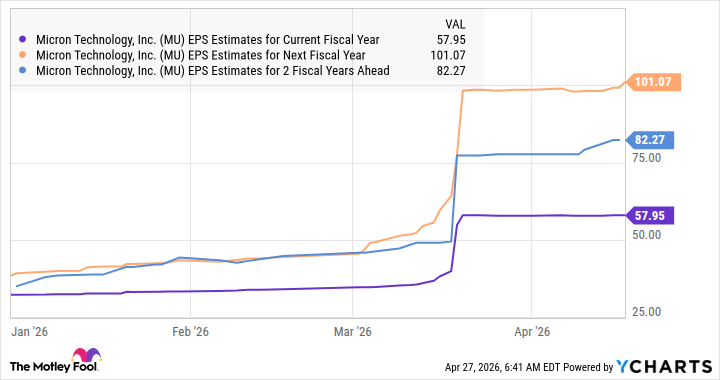
MU EPS Estimates for Current Fiscal Year data by YCharts
It is worth noting that Micron's earnings in fiscal 2025 (which ended in August 2025) stood at $8.29 per share, suggesting that its bottom line is on track to grow exponentially if it meets analysts' estimates. Of course, the above chart shows a prediction that Micron's earnings will dip in fiscal 2028, but that's unlikely given the favorable dynamics of the memory market. Another point worth noting in the chart is that analysts have also raised their earnings expectations for fiscal 2028.
Let's assume that Micron's bottom line grows at an annual rate of just 15% in fiscal 2029 and 2030; its earnings could reach $108.80 per share by the end of the decade (using predicted fiscal 2028 numbers as the base). If the stock trades at 30 times earnings at that time, a discount to the tech-focused Nasdaq-100 index's current earnings multiple of 33.4, this tech stock could be trading at $3,264 in 2030.
That math -- though not guaranteed to pan out -- puts Micron at 6.5x where it is right now. It looks like a buy now, trading at just 23 times earnings.