IonQ (IONQ +3.96%) builds trapped-ion systems that promise to solve complex problems which classical computers struggle to handle. Growth investors have bought into the narrative because the company has evolved from a lab experiment to a business generating real revenue from brand-name customers.
But IonQ stock hinges on whether quantum computing's breakthroughs arrive before the hype fades and cash burn accelerates. One year from now, I predict IonQ could be trading between $55 and $75 per share -- up to 63% upside from current levels.
Momentum from commercial traction should help lift shares, but execution risks and echoes of past tech bubbles suggest IonQ will not surge without delivering measurable quantum advantages.

Image source: Getty Images.
Why investors are bullish on IonQ
IonQ's technology uses individual atoms held by lasers to create qubits with high fidelity and long coherence times. The company's hardware powers a full-stack platform spanning computing, networking, sensing, and security, available through integrations with major cloud service providers as well as direct system sales.
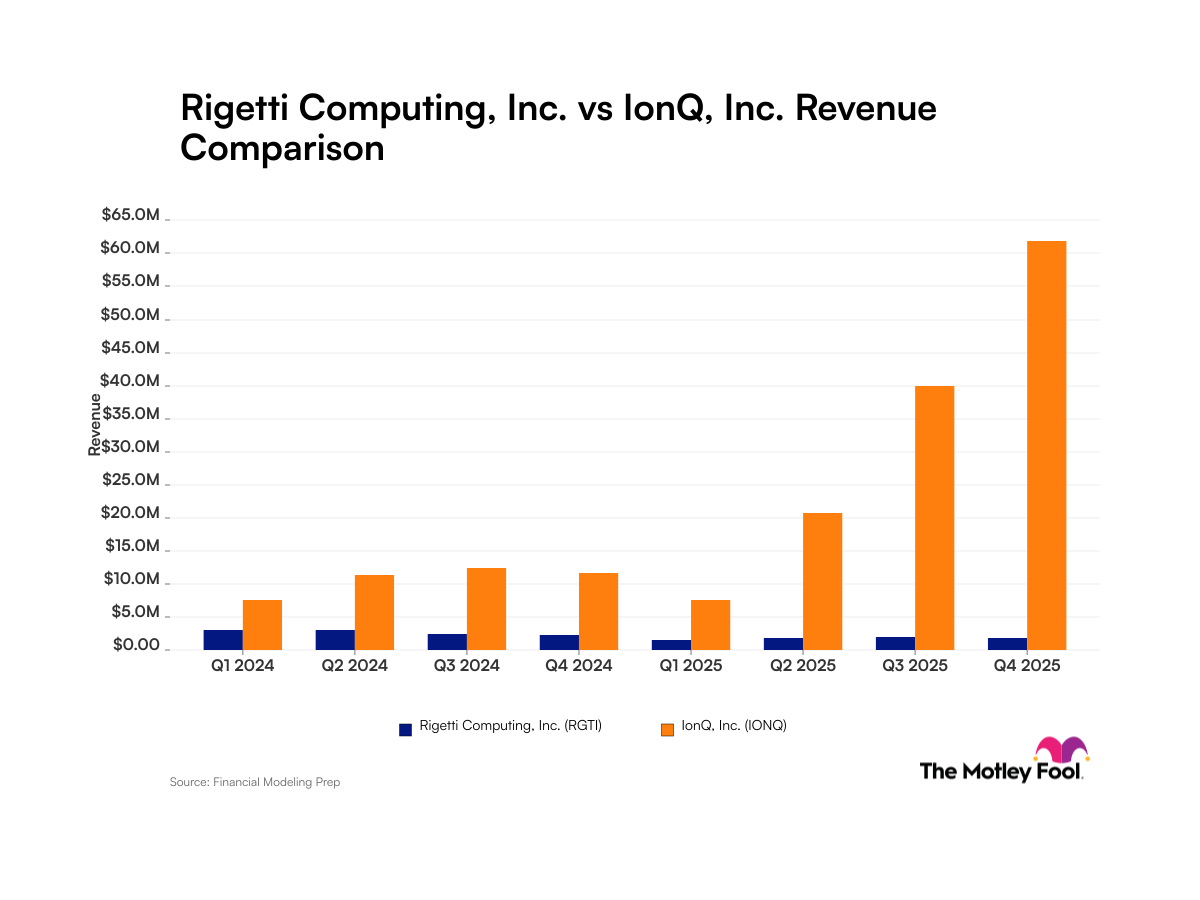
The excitement around IonQ is obvious: Governments and enterprises increasingly view quantum computing as the next multiplier for artificial intelligence (AI), logistics, and cybersecurity. IonQ ended 2025 with $3.3 billion of cash and investments on the balance sheet, as well as $370 million in backlog. While these figures make the company look equipped to scale, smart investors are looking beyond headline financials and digging into IonQ's position in an intense quantum landscape to get a sense of its long-term trajectory.

NYSE: IONQ
Key Data Points
Assessing IonQ's progress
IonQ is making a genuine, albeit narrow, difference in AI. Hybrid quantum-classical systems can improve large language models (LLMs) by capturing higher-dimensional patterns classical systems often miss.
The company's partnerships with pharmaceutical companies and automotive manufacturers have shown pilots delivering more efficient optimization compared to classical approaches. Still, broad transformation remains elusive. Fault-tolerant, million-qubit machines are many years away.
Meanwhile, today's quantum architectures primarily excel at specific optimization and simulation tasks but are not yet capable of training trillion-parameter models or upending hyperscale data centers.
While IonQ is not vaporware, the AI world has not yet been revolutionized by quantum computing just yet. The risk of investing in IonQ is that investors are pricing in decade-long payoffs while the company is still proving near-term utility.
IonQ is employing an interesting growth strategy
IonQ's revenue expansion combines organic revenue growth with aggressive acquisitions. Over the last couple of years, IonQ has spent billions on strategic buys: SkyWater Technology for domestic chip fabrication, Oxford Ionics for qubit control, and Vector Atomic for precision sensing, among others, to stitch together networking and security.
The rationale behind these deals is to create deep vertical integration and shorten design-to-production cycles. With plenty of cash on hand and rising revenue, the strategy looks sustainable for now. The caveat, of course, is that integration of its new assets delivers faster product roadmaps that ultimately offset net losses.
Many darlings of the dot-com era saw meaningful drawdowns more once the realities of the internet replaced lofty visions. Even survivors such as Cisco Systems fell roughly 80% from its peak before recovering. While IonQ has measurable revenue and technical advantages that most internet bubble-era names lacked, its valuation rests heavily on future milestones rather than its current profile.
While a sharp correction could easily occur, my base-case scenario assumes steadier revenue growth, on-time product launches, and expanding commercial wins. By this time next year, IonQ stock could be trading in line with prior highs -- which would be a reflection of genuine progress rather than pure speculation.