Nvidia (NVDA +2.57%), the world's largest company, has in recent days been dancing back and forth across the $5 trillion market cap threshold. Today, it's above that level. But those are just short-term movements. What long-term investors really want to know is when it could hit the next major milestone: $10 trillion. But is it even possible or realistic for Nvidia to get that far?
Image source: Getty Images.
How long will AI chip demand persist?
Nvidia has been one of the biggest beneficiaries of the AI build-out. Its graphics processing units (GPUs) are still the top AI computing chips available. Considering both its rapid growth and the consistent undersupply of data center chips relative to demand, I don't see this changing anytime soon. This year, Wall Street analysts project 72% revenue growth for the company. Considering all that, it's no surprise that some investors believe that a $10 trillion market cap for it is inevitable, but what would it take to get there?

NASDAQ: NVDA
Key Data Points
First, we need to establish some targets. One of those is a valuation, as Nvidia could be worth $10 trillion today if the market were willing to pay twice as much for its earnings as it is now. Nvidia currently trades for around 43 times earnings, which is far from cheap, but that premium also reflects its rapid growth. If its valuation were just 30 times earnings, it would be right in line with other big tech peers that have comfortably traded in that range for nearly a decade.
At a price-to-earnings ratio of 30, Nvidia would need to generate $333 billion in net income to justify a $10 trillion market cap. Over the past 12 months, Nvidia has generated $120 billion in net income, with a 56% profit margin on its revenues.
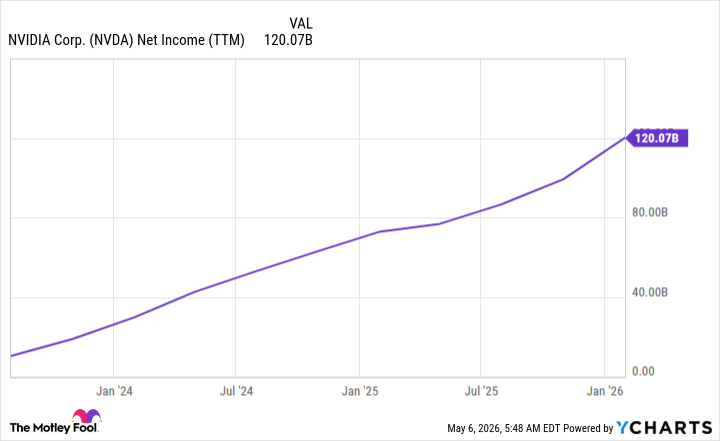
NVDA Net Income (TTM) data by YCharts.
Those are impressive figures. Let's assume that Nvidia's margins stay steady, which would result in Nvidia's net income growth equaling its revenue growth. In that case, $333 billion in net income would require about $600 billion in sales. Wall Street's consensus projection for next year's growth rate is just 31%: Analysts estimate Nvidia's sales to be about $484 billion next year, up from $370 billion this year. However, Wall Street has underprojected Nvidia's growth rate for the entirety of the AI build-out.
Considering the long-term nature of the AI infrastructure build-out and Wall Street's persistent pattern of underestimating Nvidia's growth, I think investors could reasonably expect Nvidia to hit a $10 trillion market cap in about three years. That would have the stock doubling over that time frame, making Nvidia a solid investment now.