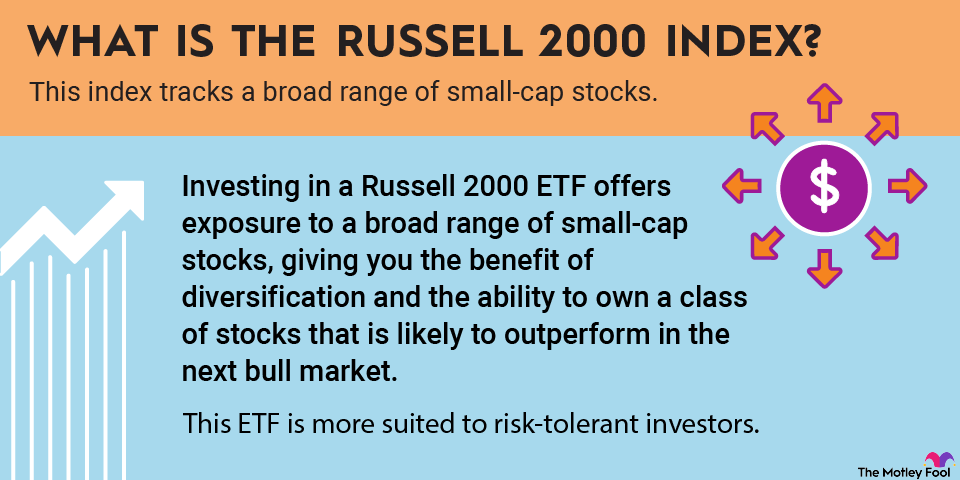
Thanks to a strong start to the year, small caps have been outperforming large caps in 2026. May has marked a turnaround, with tech and growth once again leading, but small caps continue to present a compelling investment case.
Year to date, the Vanguard Russell 2000 ETF (VTWO 0.60%) has returned 16%, far outpacing the 10% return of the Vanguard S&P 500 ETF.
But the volatility in stocks this year and the significant leadership rotations over the past six months indicate a rapidly evolving economic environment. For the Vanguard Russell 2000 ETF to continue leading, its operating environment will need to keep improving.

Image source: Getty Images.
Why small-cap stocks are finally having a moment
Small caps have trailed large caps for several years, primarily on the heels of corporate earnings. Large caps have collectively been able to deliver solid earnings growth since 2023, on the heels of the Magnificent Seven boom.
Small caps haven't had the same environment. They've been struggling to generate sustainable earnings growth for a while. The impact of tariffs, higher inflation, and higher interest rates, which often hit smaller companies harder than larger ones, has been especially damaging.
But the environment is beginning to change. Annualized small-cap earnings growth is expected to hit double digits in 2026 and narrowly catch up to large-cap growth rates. If the earnings growth rates become more comparable, the valuation gap between the two groups -- the Vanguard Russell 2000 ETF trades at a forward price/earnings (P/E) ratio of 15 versus 20 for the Vanguard S&P 500 ETF -- tilts the better risk/reward profile in favor of small caps.

NASDAQ: VTWO
Key Data Points
Small caps require different catalysts than the S&P 500
Small caps have a very different composition from large caps. The top three sector holdings in the S&P 500 ETF are Technology (35%), Financials (12%), and Communication Services (12%). The Russell 2000 ETF's top three are Industrials (20%), Healthcare (16%), and Financials (16%).
That makes small caps much more cyclically sensitive and exposed to changes in economic conditions. Small caps may perform better in accelerating growth environments, but large caps could lead in more mature, peak-cycle regimes.
Profitability will also be a key factor, as we've already seen recently. Roughly 40% of Russell 2000 components are unprofitable. That means they could get hit especially hard during an economic slowdown.
But the positive momentum for small caps and the Vanguard Russell 2000 ETF doesn't look over yet. If these companies can hit or exceed their earnings growth estimates, there's enough inherent value to help them outperform the S&P 500 for a longer time.