ExxonMobil (XOM 0.87%) is one of the world's largest oil companies. When oil prices rise, investors tend to buy the stock, pushing its price up along with oil prices. That's exactly what's happened in 2026, with Exxon's shares higher by 24% as of this writing. That's more than twice the gain of the S&P 500 index (^GSPC +0.36%), which is up "only" 10%.
The interesting fact here is that a 10% gain for the S&P 500 is actually pretty impressive, given that the year isn't even half over yet. Historically speaking, 10% is about the return investors expect from the market, on average. So, by comparison, Exxon's advance is shockingly large. This is what's going on and why I believe Exxon will still be ahead of the S&P 500 when 2026 draws to a close.

Image source: Getty Images.
Emotions are the driving force on Wall Street
Over the long term, Wall Street is fairly good at assigning value. In the short term, however, emotions tend to hold sway. That often results in prices that move too far in one direction or the other. This is very clear when you look at NuScale Power's (SMR +4.27%) price chart. The company is a money-losing nuclear power start-up seeking to break into the electricity industry with new technology.
It isn't a bad company, and the small modular nuclear reactors (SMRs) it wants to build are an exciting development. But it hasn't yet built a single SMR for sale. And yet the stock soared based on nothing more than investor enthusiasm. When Wall Street's interest waned, the stock plunged. Nothing material has changed about the company; the stock's rise and fall were largely driven by investor emotions.
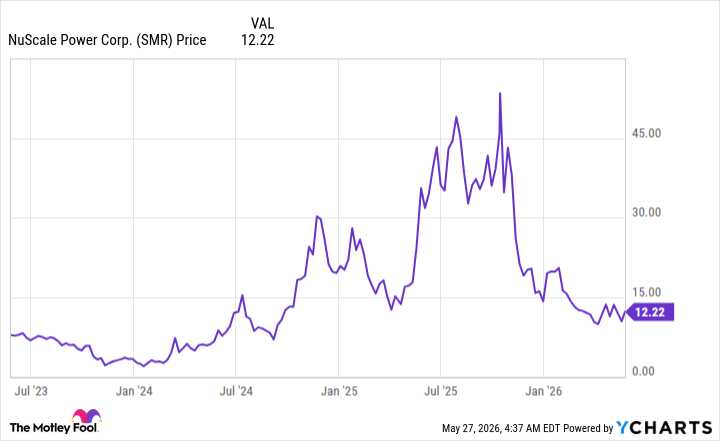
This dynamic applies throughout Wall Street, including to ExxonMobil today.
Exxon's stock is up because oil is up
Exxon is benefiting from investor enthusiasm right now. Only, the excitement around the stock is tied to a very real-world event: the geopolitical conflict in the Middle East. The supply disruption caused by the conflict has left the world short of oil and natural gas. As commodities, limited supply has pushed energy prices higher. That, in turn, has led investors to buy Exxon, one of the world's largest energy companies, expecting strong financial results.
That's not unreasonable, though it is likely that Exxon's price will decline as oil prices fall. That could happen when the Middle East conflict ends. But there's a complication here. The global oil market is complex and interconnected. Energy executives are warning that supply shortages aren't fully reflected in oil prices and that a return to normal in the industry could take months.

NYSE: XOM
Key Data Points
So, stepping back, Exxon has a big lead on the S&P 500 index at this point in the year. And every day that passes, the world's energy shortfall worsens, and the time it takes to return to normal grows longer. Energy prices could initially fall as investors react to the end of the conflict, but when industry fundamentals take hold, oil and gas prices are likely to either rise again or, at the very least, remain elevated.
That suggests Exxon's stock price could easily remain elevated all year. So the S&P 500 would need to rise dramatically from here to close the performance gap.
Exxon's early lead could make it the winner in 2026
Of course, there's no way to predict the future. Given the fundamentals of the oil market, it seems likely that oil prices will remain elevated even after the Middle East conflict ends. And that, in turn, is likely to keep Exxon's price high. Unless the S&P 500 rises materially from here, I think Exxon will end up the bigger winner in 2026.