When people decide to buy dividend stocks, they're usually looking for safety. That doesn't mean these stocks are "safe," because no stocks are. All stocks carry a risk of loss. But investing in high-yield dividend stocks often means buying into high-quality companies with strong balance sheets.
Dividend exchange-traded funds (ETFs) might not be flashy like tech stocks, but people don't buy dividend ETFs expecting rapid growth. Instead, investing in these funds is a matter of "slow and steady wins the race." This type of investment tends to be less volatile than the major tech companies, even if it doesn't grow as fast.
Two of the best dividend index funds, the Vanguard High Dividend Yield ETF (VYM 0.01%) and the Schwab U.S. Dividend Equity ETF (SCHD 1.01%), both invest in targeted portfolios of high-quality U.S. companies that pay steady yields to investors. Both funds have strongly underperformed the S&P 500 index over the past five years, but are outperforming it so far in 2026.
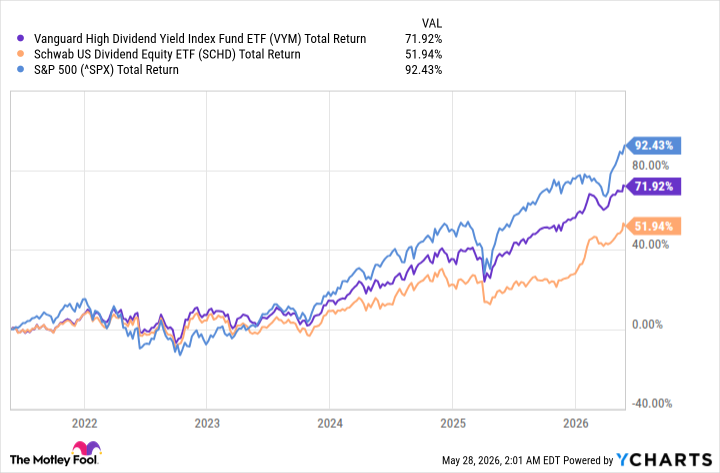
VYM Total Return Level data by YCharts
These funds might not beat the market. But they could be worth a look if you want steady dividend income during times of volatility and uncertainty.
Let's see which stock ETF could be the better choice for your portfolio.
Vanguard High Dividend Yield ETF (VYM): More than 600 stocks, 2.24% dividend yield
The Vanguard High Dividend Yield ETF offers exposure to 608 stocks, all from U.S. companies expected to deliver higher-than-average dividends. The fund's dividend yield is 2.24% at recent prices, and its expense ratio is an ultra-low 0.04%.
During the past year, this fund has delivered a 29.5% return (by net asset value) with annualized returns of 11.9% over the past five years. Even though those returns might sound impressive, this fund has underperformed the S&P 500 during both periods.

NYSEMKT: VYM
Key Data Points
What's in this fund? A well-diversified mix of sectors. Financial stocks make up the largest percentage of the fund's holdings (20.2%), followed by technology (14.8%), industrials (14.2%), healthcare (11.8%), and energy (9.7%).
As for the specific companies, as of April 30, the top five holdings are:
- Broadcom (AVGO +2.94%) (8.03% of the fund)
- JPMorgan Chase (JPM 0.91%) (3.34%)
- ExxonMobil (XOM +2.84%) (2.72%)
- Johnson & Johnson (JNJ 0.81%) (2.3%)
- Caterpillar (CAT 1.05%) (1.72%)
The rest of the top 10 include three of the best high-yield dividend stocks: AbbVie (ABBV 2.20%) (1.56% of the fund), Chevron (CVX +1.71%), and Procter & Gamble (PG 2.24%). If you're looking to diversify away from major tech names and into different parts of the economy that might be less exposed to the artificial intelligence (AI) boom, this ETF could do the trick -- except for Broadcom, which is a major AI stock that makes up a surprisingly top-heavy 8% of the fund.
Schwab U.S. Dividend Equity ETF (SCHD): 103 stocks, 3.29% dividend yield
The Schwab U.S. Dividend Equity ETF is a low-cost stock ETF that tracks the Dow Jones U.S. Dividend 100 Index. This fund only holds 103 stocks, making it slightly less diversified than the Vanguard ETF. The Schwab fund's expense ratio is also quite low, at just 0.06%.
This fund has outperformed the S&P 500 and the Vanguard High Dividend Yield ETF this year, with a total return of about 17.8% (by net asset value) year to date. In the past year, its total return was about on par with the S&P 500.

NYSEMKT: SCHD
Key Data Points
Unfortunately, its long-term performance has lagged behind both of these other investments. The Schwab U.S. Dividend Equity ETF has delivered annualized returns of about 9.1% over the past five years. Its top sector holdings are consumer staples (19.4% of the fund), healthcare (18.8%), energy (16.9%), industrials (11.5%), and information technology (11.1%).
One bright spot is that this fund delivers strong dividends, with a yield of 3.29% at recent prices. Its top stock holdings include:
- Qualcomm (QCOM 8.78%) (6.7% of the fund)
- Texas Instruments (TXN 4.08%) (6.3%)
- UnitedHealth Group (UNH 0.08%) (5.03%)
- Coca-Cola (KO 0.42%) (4.01%)
- Merck (MRK 2.99%) (3.9%).
Which fund to buy: VYM or SCHD?

Image source: Getty Images.
Both ETFs rank among the best dividend index funds. Both charge ultra-low expense ratios. Both offer a good mix of stocks that are likely less exposed to risks of a tech downturn or AI bubble. Both might be undervalued based on their price-to-earnings (P/E) ratios -- 21.38 for the Vanguard ETF, and 19.31 for the Schwab fund -- which are significantly lower than the S&P 500 index's earnings multiple of 32.40.
I don't own either fund. But if I had to choose one, I'd go with the Vanguard High Dividend Yield ETF. The biggest reason: The Vanguard ETF is more diversified (608 stocks instead of 103). If I were going to buy a dividend fund, my goal would be diversification and a sense of relative safety. I wouldn't want to put too much weight on only 103 stocks.