Large organizations typically use more than one cloud provider to run their operations, because it gives them more flexibility and minimizes disruptions if one suffers an outage. That means their valuable data is often spread across different platforms like Microsoft Azure and Amazon Web Services, which creates technical challenges.
Snowflake's (SNOW 7.61%) Data Cloud enables organizations to aggregate all of their information no matter where it is stored, so they can analyze it more effectively and extract any valuable insights. Unified data sets are also critical when deploying artificial intelligence (AI) models, because accessing the most up-to-date information results in the most accurate outputs.
Snowflake is experiencing blistering demand for its growing portfolio of AI products, which sparked a surge in the company's revenue during the fiscal 2027 first quarter (ended April 30). Snowflake stock has now more than doubled from its 52-week low that was set in April, but is there still time to buy? Read on for the surprising answer.

Image source: Getty Images.
Positioning for the AI boom
Snowflake's flagship AI platform, Cortex AI, enables enterprises to combine their internal data with the latest large language models (LLMs) from leading third parties such as OpenAI and Anthropic, to rapidly create custom AI software. The platform also offers a series of ready-made AI tools, such as Document AI, which pulls data from unstructured sources like contracts and invoices to include in the development process.
Then there is Cortex Code, an extremely powerful AI agent that can accelerate the development of data workflows. It understands natural language, so programmers can use simple prompts to complete highly complex tasks. Think of it like ChatGPT, except it has access to the organization's entire Snowflake environment and all associated data, so it understands the context behind every request.
Snowflake had 13,912 customers at the end of the fiscal 2027 first quarter, and 13,600 -- or practically all of them -- were using at least one of the company's AI tools.
Snowflake's revenue growth just accelerated
Snowflake generated $1.33 billion in product revenue during the first quarter, which was comfortably above management's forecast of $1.26 billion. It represented a year-over-year increase of 34%, so the company is already growing faster than it did in fiscal 2026 overall, when product revenue increased by 29%.
The strong result prompted management to lift its full-year guidance for fiscal 2027. Snowflake is now expected to generate $5.84 billion in product revenue for the year, compared to the previous forecast of $5.66 billion.

NYSE: SNOW
Key Data Points
But Snowflake's first-quarter growth came at a significant cost. Sharp increases in marketing as well as research and development spending contributed to a generally accepted accounting principles (GAAP) net loss of $295.5 million during the period. While that was a 31% reduction from the year-ago loss, the company is still a long way from sustained profitability, which will restrict management's ability to invest more aggressively to build more AI products.
Snowflake was profitable to the tune of $148 million on an adjusted (non-GAAP) basis in the first quarter, but only after stripping out a whopping $433.6 million in stock-based compensation costs. Although that cost is technically a noncash expense, investors shouldn't dismiss it, because existing shareholders get diluted every time new shares are issued, which could dent their future returns. It followed over $1.7 billion in stock-based compensation costs in fiscal 2026, so this has been an ongoing theme for the company.
Wall Street thinks there is surprisingly little upside ahead
The Wall Street Journal tracks 43 analysts who cover Snowflake stock, and although 41 have given it a buy rating, their average price target is just $283.11. That implies a potential upside of only 14% over the next 12 months, so perhaps most of the near-term gains have already been realized.
Snowflake's high valuation might be a reason for Wall Street's cautiousness. It's a unique company with few comparables in the public markets, but with a price-to-sales (P/S) ratio of 16.9, it's significantly more expensive than cloud giants like Microsoft, Amazon, and Alphabet, which also offer extensive portfolios of AI products and services:
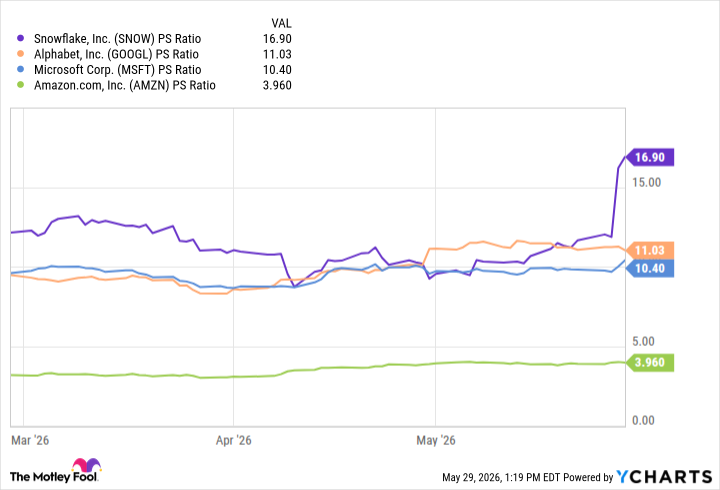
SNOW PS Ratio data by YCharts
Microsoft, Alphabet, and Amazon operate many other businesses outside of cloud computing, so this valuation comparison isn't ideal. However, I will point out that Microsoft Azure grew its revenue by 40% during its most recent quarter, while Alphabet's Google Cloud grew its revenue by a whopping 63%. Not only are those platforms growing faster than Snowflake, but they also generate far more revenue, which makes the faster growth even more impressive.
As a result, I think Snowflake's premium valuation is tough to justify, so it might not be a great buy right now. A better choice might be Microsoft, which offers many of the same AI-related upside catalysts at a much more attractive price.