The Department of Commerce recently announced letters of intent to invest $2 billion across nine quantum computing companies under the CHIPS and Science Act. In exchange, the government will receive a minority equity stake in each business.
With the U.S. government becoming a shareholder in the quantum industry, smart investors should start paying serious attention to how this technology could become the next frontier in artificial intelligence (AI).

Image source: Getty Images.
Why is the government investing in quantum computing stocks?
The Commerce Department's rationale behind backing these quantum computing companies was straightforward: These investments will be used to build a domestic manufacturing base for quantum chips and accelerate the research and development (R&D) needed to produce practical quantum computers at scale.
Two recipients in particular are being funded to lead the manufacturing infrastructure. International Business Machines (IBM 5.61%) will receive $1 billion and establish a new quantum foundry subsidiary called Anderon. Meanwhile, GlobalFoundries (GFS 10.83%) is raising $375 million to build a complementary foundry capable of serving broader quantum architectures, including superconducting, trapped-ion, and photonics.
The remaining companies -- Atom Computing, Diraq, D-Wave Quantum (QBTS 13.71%), Infleqtion, PsiQuantum, Quantinuum, and Rigetti Computing (RGTI 14.40%) -- each received up to $100 million in funding to help address specific engineering variables and modalities.

NASDAQ: RGTI
Key Data Points
Among the government's quantum investments, which ones can retail investors buy?
Both IBM and GlobalFoundries are publicly traded. However, their primary stories revolve around enterprise technology and semiconductor manufacturing. In reality, quantum computing is a small, niche piece of each company's AI roadmap today.
IBM's exposure to quantum computing is being outsourced to Anderon, a separate subsidiary. This means buying IBM stock does not provide investors with direct access to upside from commercialized quantum AI. The subsidiary structure effectively insulates IBM from operating losses that come with developing quantum systems.
Among the pure-play quantum companies, the public names are D-Wave, Rigetti, and Infleqtion. The remaining four -- Atom Computing, Diraq, PsiQuantum, and Quantinuum -- are currently private.
That said, Quantinuum is not completely out of reach. The company recently filed an S-1 with the Securities and Exchange Commission (SEC), suggesting an IPO could be on the horizon sooner rather than later.
Moreover, investors have several options to gain passive exposure to Quantinuum. The company is majority-owned by Honeywell (HON 1.69%); meanwhile, Nvidia (NVDA 5.93%) participated in Quantinuum's $600 million funding round back in September. Buying shares of Honeywell or Nvidia quietly puts a portion of your portfolio in the quantum opportunity.
Are quantum computing stocks good buys right now?
In my eyes, the honest answer about whether quantum computing stocks are good buys is that they can be, but investors need to be selective and measure appropriate risk tolerance.
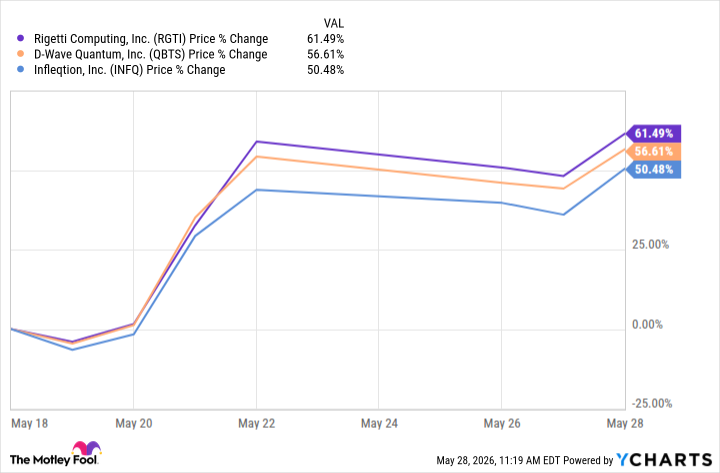
Each of the pure-play public names jumped sharply on the funding announcement. This means that some good news is already priced in. The funding from the CHIPS Act should help reduce near-term capital risk and extend development runways. However, D-Wave, Rigetti, and Infleqtion are still early-stage businesses operating in a capital-intensive sector where commercial timelines are measured in years.
For investors with a long-term horizon and who are comfortable with volatility, any pullbacks that follow announcement spikes are better entry points than chasing momentum right now. For those who prefer a lower-risk angle, Honeywell, Nvidia, and IBM still offer diversified, compelling ways to ride the quantum computing wave without getting overextended.