It makes sense to want to invest in a dividend exchange-traded fund (ETF) primarily for its dividend yield. After all, that's generally what separates them from other non-dividend-focused ETFs. That said, a dividend ETF's current yield isn't generally what matters most in the long run.
Of the five dividend ETFs with the most assets under management (AUM), the Vanguard Dividend Appreciation ETF (VIG 1.37%) has the second-lowest yield, even though it's the largest ETF in the bunch.
| ETF | Dividend Yield | AUM |
|---|---|---|
| Vanguard Dividend Appreciation ETF | 1.47% | $107.9 billion |
| Schwab U.S. Dividend Equity ETF | 3.25% | $94.9 billion |
| Vanguard High Dividend Yield ETF | 2.21% | $78.4 billion |
| iShares Core Dividend Growth ETF | 1.96% | $40.3 billion |
| Capital Group Dividend Value ETF | 1.17% | $35.0 billion |
Data sources: YCharts and VettaFi. Dividend yields as of market open on April 1. AUM=assets under management.
So then why do so many people have money in VIG if its yield is hovering around average, and others have much higher yields? Because of where the dividend payouts are headed -- not where they currently stand.

Image source: Getty Images.
A different approach to dividends
Instead of placing heavy emphasis on companies with high dividend yields, this Vanguard fund focuses on companies that have consistently increased their annual dividends. To be included, a company must have at least 10 consecutive years of increases and not be in the top 25% highest-yielding eligible companies.
Because its criteria focus on payouts rather than ultra-high yields, VIG holds many more growth-leaning stocks than typical dividend stocks. For example, its top three holdings -- Broadcom, Apple, and Microsoft -- don't usually come to mind when you think about dividend stocks, but they've been consistent for years, with 14, 15, and 21 consecutive years of increases, respectively.
With the tech sector accounting for 25% of VIG, it has a much stronger growth profile than many other dividend ETFs. Yes, you sacrifice a bit of yield, but it's a two-for-one that most other dividend ETFs don't offer.

NYSEMKT: VIG
Key Data Points
Keep your eyes on the long-term prize
Since its April 2006 inception, the Vanguard ETF's dividend payout has increased by 750%. This fluctuates and isn't as straightforward as individual stocks because different companies in the ETF pay out dividends at different times. However, it shows its core focus is paying off as intended.
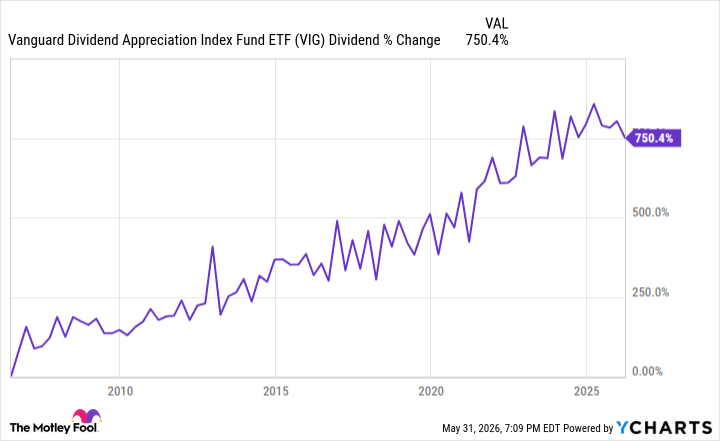
VIG Dividend data by YCharts
No one can say how the increases will play out over the next 20 years, but I'm willing to bet the growth will be impressive. VIG's current yield won't have income investors jumping for joy, but it's a great dividend ETF to hold for the long haul. A consistently increasing dividend can do a lot for a stock's or ETF's total returns because of how it compounds.