It's official: Micron Technology (MU -3.07%) has surpassed a market cap of $1 trillion, making it the 12th-most-valuable company in the world. The memory chipmaker is benefiting from the build-out of artificial intelligence (AI) infrastructure, with its stock up nearly 1,000% over the last year. As of this writing on June 2, 2026, Micron has zoomed even higher to a market value of approximately $1.2 trillion.
What's next for Micron? Is the market getting ahead of itself with this AI beneficiary? Let's dive into the numbers and find out.

Image source: Getty Images.
Booming prices and a supply crunch
Memory chips are used by all types of computing devices to store and subsequently retrieve data needed for tasks. Think of it like a filing cabinet, but for a computer. AI is driving the need for more memory chips in devices and cloud computing data centers to better run inference for various intelligent software programs.
With supply not set up to meet this catalyst-driven demand, spot prices for memory chips have tripled over the last few years. To secure supplies at reasonable prices, many big technology players investing in AI infrastructure have reached out to memory chipmakers to lock in pricing and secure orders.
Demand outstripping supply has helped Micron generate record revenue and profits. Last quarter, revenue was $24 billion, with $16 billion in operating income. That is an operating margin of 68%, showing the pricing power Micron has flexed with customers.
Next quarter, Micron expects $33.5 billion in revenue, which is higher than its annual revenue in any year before 2025.

NASDAQ: MU
Key Data Points
Taking a multiyear view
Where investors are getting extra bullish on Micron is the company's trajectory over the next few years. Net income was $24 billion over the last 12 months, with most of these earnings coming last quarter.
If revenue continues to increase, analysts expect the company to report net income of more than $100 billion in both 2027 and 2028. Of course, this means spending on AI infrastructure continues, but there is no sign that Micron's AI customers are set to slow down.
Compared to a market cap of $1.2 trillion, $100 billion in net income would mean a forward price-to-earnings ratio (P/E) of just 12 for Micron. Investors betting on the stock today believe that AI has changed the game for memory chips, giving them durable demand with locked-in contracts at higher prices. If this is the future of the sector, then a $1.2 trillion valuation for Micron may actually undervalue its earnings power over the next decade, despite the stock rising 1,000% over the last year or so.
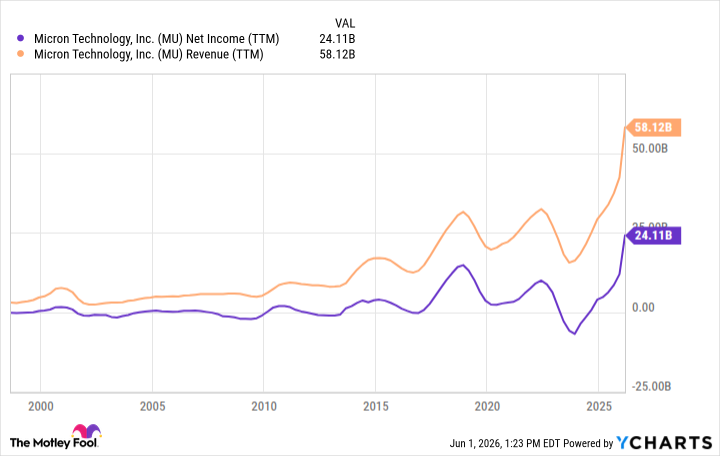
Data by YCharts.
What happens next for Micron stock?
Where Micron stock trades over the next decade will solely be determined by its ability to keep memory chip prices elevated.
It all comes down to forward-looking demand from the AI infrastructure build-out. If the AI bulls are correct and sector revenue grows exponentially, we should keep seeing demand for memory chips outstrip supply for years, with long-term contracts locking in fat profits for Micron.
However, this is not how the memory market has operated historically. Take a look at the above revenue chart for Micron as a clear example. Long lead times and uncertain demand eventually cause memory chipmakers like Micron to oversupply the market, creating a glut and driving prices down.
If there is even a hint of supply reaching demand and memory chip prices falling, Micron's stock is liable to crash at some point within the next few years. Unless you are a firm believer in the exponential demand coming from AI, it is best to stay away from Micron stock after its miraculous run.