While the market remains mesmerized by artificial intelligence (AI) stocks, there is a sector of the old economy that has outperformed over the past month.
Airline stocks United Airlines (UAL +0.75%), Delta Air Lines (DAL 0.11%), and Southwest Airlines (LUV +0.56%) are up handsomely, with Delta even outperforming the S&P 500 in 2026 with its 17.4% rise so far. These are somewhat surprising developments, given that the war in Iran has sent the price of oil and jet fuel soaring.
Airline stocks and soaring fuel prices
The following chart shows a broad-based recovery over the past month.
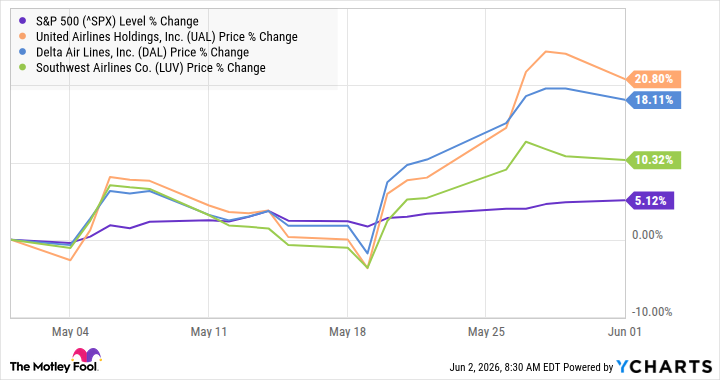
Data by YCharts.
It's surprising, given that oil prices are still in the $90-per-barrel range, compared with $60 per barrel before the conflict began. Moreover, the unavailability of crude oil and refined products that typically flow through the Strait of Hormuz has sent jet fuel crack spreads soaring this year.
For example, Delta CEO Ed Bastian said, "The war in the Middle East has driven an unprecedented spike in jet fuel, with prices roughly double what they were earlier in the year." The company declined to update its full-year guidance because of the uncertainty created by the conflict and its impact on jet fuel prices.

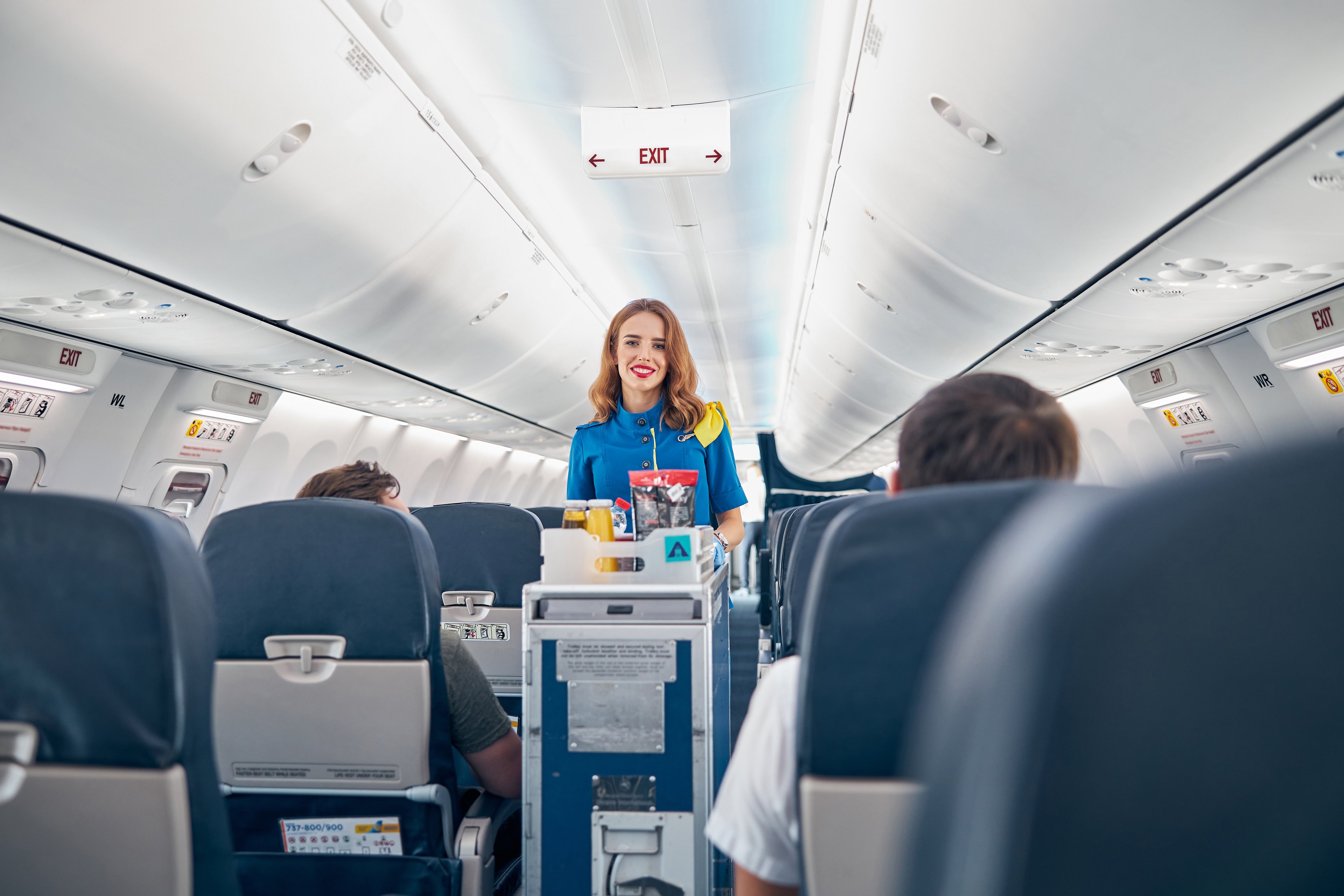
Image source:Getty Images.
Wall Street downgrades expectations
That said, investors and Wall Street analysts have wasted no time in lowering expectations for airline stocks. Here's how the Wall Street consensus for adjusted diluted earnings per share (EPS), according to S&P Global Market Intelligence/Visible Alpha, has been lowered over the past three months for all three stocks.
|
Airline |
EPS Estimate |
Current |
EPS Estimate |
Current |
|---|---|---|---|---|
|
United Airlines |
$13.33 |
$9.46 |
$15.24 |
$14.59 |
|
Delta Air Lines |
$7.19 |
$5.54 |
$8.20 |
$8.05 |
|
Southwest Airlines |
$4.37 |
$2.71 |
$5.27 |
$4.44 |
Data source: S&P Global Marketplace/Visible Alpha.
There's a pronounced reduction in 2026 earnings expectations, but Delta and United's expectations haven't changed much for 2027.
Why Delta and United have outperformed
All the airlines have been able to increase pricing to offset higher fuel costs because end demand remains high, and the market is pricing in a resolution to the conflict.
Regarding end demand, Delta's Bastian said in April, "The acceleration we saw in March is carrying forward into the June quarter." At the end of May, United CEO Scott Kirby said, "As everyone knows, demand has remained strong as is well publicized." That came at the same investment conference where Robert Jordan, CEO of low-cost airline Southwest, said:" [T]he consumer remains very strong despite this rise in fares. So I'm becoming increasingly bullish that we will be able to cover these fuel increases with revenue increases."
Where next for airlines
While airlines have reduced capacity in response to rising fuel prices and earnings estimates have come down, Delta and United, in particular, have demonstrated they can push through price increases in the current environment, and they are likely to emerge as winners from a period of capacity constraints.
Moreover, both airlines have diversified their revenue streams, making them relatively insulated from the industry's decades-long cyclicality. Delta in particular remains a top stock to buy for 2026.