Nvidia (NVDA 5.93%) has been a life-changing investment in this golden era of artificial intelligence (AI). The stock has risen more than 1,070% over the past five years. That turns $10,000 into over $116,680. With AI investments continuing to pour into chips and data centers, it's fair to wonder how much more investors can expect.
Could Nvidia, already at a market cap of $4.96 trillion, with a "T," actually double again anytime soon? The idea isn't outlandish at all. Nvidia's next AI chip platform, Vera Rubin, is looming, and it represents a leap forward in data center infrastructure.
Here's why Nvidia stock can continue to soar and how long it may realistically take to double from here.
Image source: The Motley Fool.
Vera Rubin is coming
Nvidia has built its empire on its prior AI chip platforms, Hopper and Blackwell. Vera Rubin takes Nvidia's data center dominance to a new level. That platform actually consists of six components:
- Vera CPU
- Rubin GPU
- NVLink 6 switch
- ConnectX-9
- BlueField-4 data processing unit (DPU)
- Spectrum-6 Ethernet switch
Essentially, Nvidia is expanding its footprint within the server rack.
Nvidia states that together, these chips form an AI supercomputer, designed for AI data centers. Nvidia CEO Jensen Huang has noted that the company has $1 trillion in cumulative orders for the Blackwell and Vera Rubin chip platforms across 2026 and 2027. Nvidia will begin shipping Vera Rubin later this year.
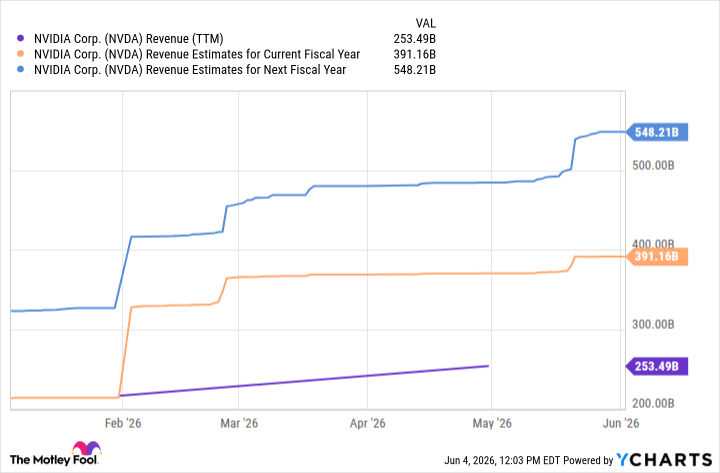
With all that business lined up, Nvidia's top line may not take long to double. Analysts expect sales to more than double from its trailing-12-month figures by the end of next fiscal year.
Data by YCharts
The math says Nvidia can realistically double, but when?
If Nvidia continues to deliver up to expectations, investors may not have to wait long.
The stock currently trades at 33 times its trailing-12-month earnings per share of $6.53. Analysts currently see Nvidia growing earnings per share by 35% to 36% annually over the next three to five years. At that rate, earnings will double in just over two years from now. If Nvidia simply maintained its current valuation, there you go.

NASDAQ: NVDA
Key Data Points
So, what happens if something goes wrong?
Suppose annualized earnings growth is actually slower, like 20% instead. Not only would it mathematically take longer for earnings to double, but investors probably wouldn't pay as high a valuation to own shares. At 20 times earnings, Nvidia would need to earn about $21.80 per share for the stock to double from its current share price. Nvidia's earnings would reach that number in six to seven years at that 20% annualized growth rate.
The good news? Barring Nvidia's market share imploding or the broader AI boom completely unraveling, Nvidia stock seems poised to continue higher over the long term. Whether it's two years or seven years, investors should be happy tucking shares away in a long-term portfolio and waiting for the business to keep doing its thing.