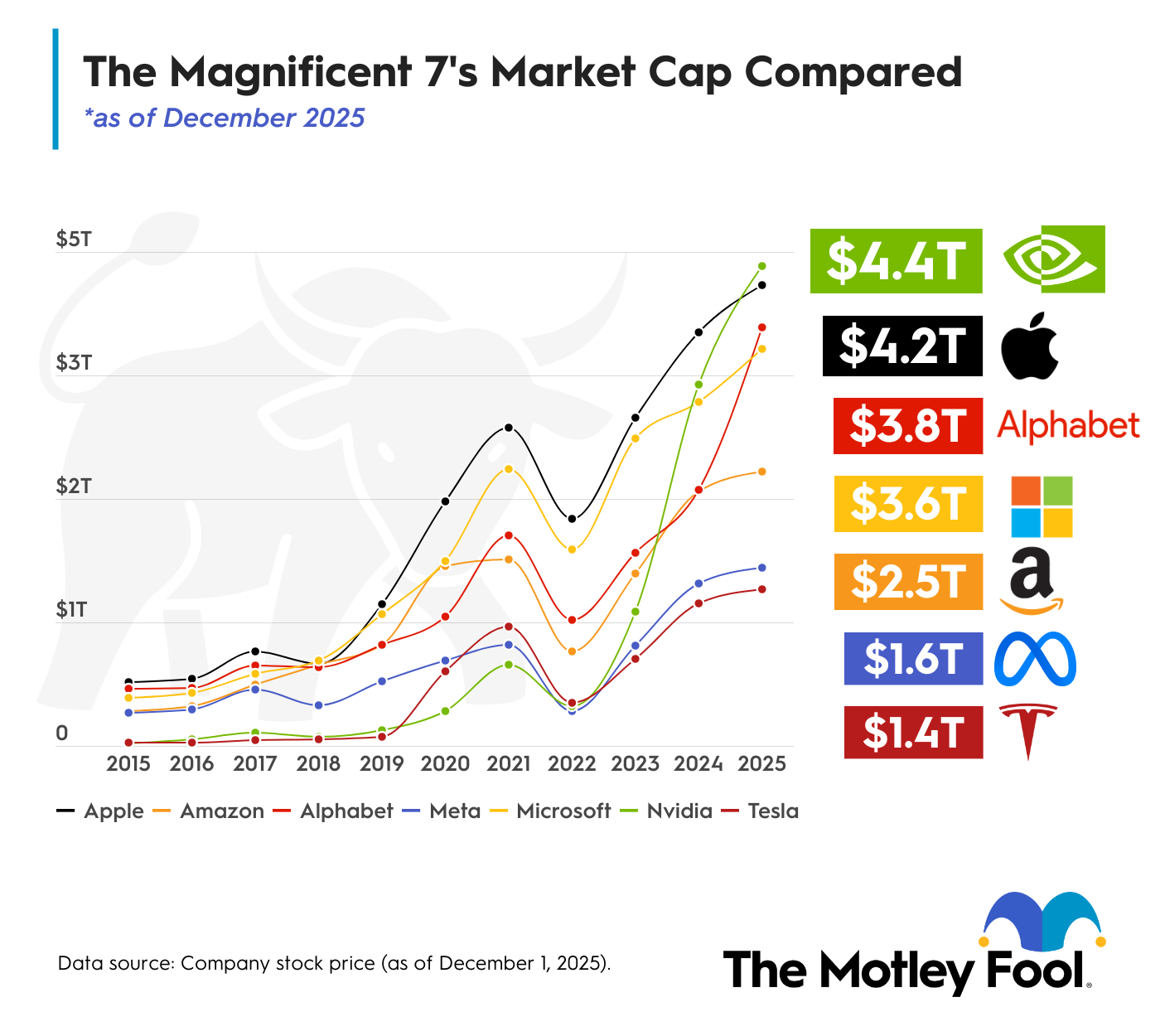
Shares of Nvidia (NVDA +1.74%) and Broadcom (AVGO +2.61%) have gained nearly 442% and 401% in the past three years. After such extraordinary gains, investors may wonder whether there is still enough upside potential left in these stocks or whether the artificial intelligence (AI) opportunity is already priced in.

Image source: Getty Images.
That question becomes harder because Nvidia and Broadcom are not rallying on hype alone. Nvidia's revenue rose 85% year over year to $81.6 billion in the first quarter of fiscal 2027 (ending April 26, 2026), while data center revenue rose 92% year over year to $75.2 billion. Broadcom also saw revenue rise 48% year over year to $22.2 billion in the fiscal 2026 Q2 (ending May 3, 2026).
So the question is not whether these are real AI winners. The question is whether future growth can still exceed the expectations already built into their stock prices. History offers a useful way to understand that risk.
History says valuation still matters
In their 1998 Journal of Finance paper, "Value versus Growth: The International Evidence," Eugene Fama and Kenneth French found that value stocks outperformed growth stocks in 12 of 13 major markets from 1975 to 1995. The global return spread between high and low book-to-market stocks was about 7.6 percentage points per year.
In another 2020 paper, "A Growth Adjusted Price-Earnings Ratio," Graham Baird, James Dodd, and Lawrence Middleton studied stocks listed on major U.S. stock exchanges from 1990 to 2015. The authors found that stocks with low growth-adjusted price-to-earnings (P/E) ratios outperformed stocks with high growth-adjusted P/E ratios in both absolute and risk-adjusted terms.
Together, these studies highlight that while growth matters, it should come at the right price. Investors can overpay even for companies with strong fundamentals if too many years of exceptional growth are already reflected in the stock. That is the real risk with Nvidia and Broadcom today.
Nvidia's growth prospects
Nvidia's top line is still growing at an impressive pace. Management is guiding for Q2 revenue in the range of $89.2 billion to $92.8 billion despite assuming no contribution from China data center compute business. Hence, even though restrictions in the Chinese market remain a real headwind, Nvidia expects Q2 revenue to grow year over year in the range of 91% to 98.7%.

NASDAQ: NVDA
Key Data Points
Hyperscaler revenue grew 12% sequentially to $38 billion or roughly half of the total data center revenue in Q1. ACIE revenue, which includes AI clouds, industrial, and enterprise AI, grew 31% sequentially to $37 billion. Hence, beyond hyperscaler customers, Nvidia is also expanding its presence in AI-native clouds, enterprise AI factories, industrial use cases, and sovereign AI projects.
Networking is also emerging as a major growth catalyst. Nvidia's data center computing revenue grew 77% year over year to $60 billion in Q1. But data center networking revenue almost tripled year over year to $15 billion. Nvidia has positioned itself as a full-stack AI player, providing graphics processing units (GPUs), high-speed networking, software, and systems integration needed for AI infrastructure.
Nvidia is also developing new technologies to turn today's AI demand into a multigeneration upgrade cycle. Vera Rubin, Nvidia's next-generation CPU-GPU platform, is expected to start production shipments in the second half of calendar year 2026, beginning in Q3 of fiscal 2027. The company expects Vera, its next-generation central processing units (CPU) for agentic AI workloads, to open a new $200 billion addressable market. The company also has visibility to nearly $20 billion in CPU revenue in calendar year 2026. Nvidia also expects roughly $1 trillion in revenue from the sale of Blackwell and Rubin systems from 2025 through calendar 2027. That makes Nvidia's growth story less dependent on one GPU generation and more tied to a multiyear AI infrastructure cycle.
However, despite these tailwinds, Nvidia will likely need to consistently surpass analyst expectations in the earnings results to drive future share price growth.
Broadcom's growth strategy
Broadcom has become a key supplier of custom AI accelerators and AI networking chips for building AI infrastructure globally.

NASDAQ: AVGO
Key Data Points
Broadcom is seeing solid traction not only in revenues but also in overall bookings. The company's AI semiconductor revenue was up 143% year over year to $10.8 billion, while AI semiconductor bookings reached over $30 billion at the end of Q2. This implies that customers are ordering well ahead of delivery.
Management now expects AI semiconductor revenue to grow about 180% year over year to $56 billion in fiscal 2026. The company also reiterated its fiscal 2027 AI semiconductor revenue guidance of over $100 billion and expects growth to continue even in fiscal 2028.
Large customer commitments back the revenue visibility. Alphabet's Google has entered into a long-term agreement with Broadcom to design and develop multiple generations of Tensor Processing Units (TPUs) and AI networking components. Anthropic, OpenAI, and Meta Platforms also have multigigawatt deployment plans with Broadcom that extend into 2027, 2028, and even 2029. With significant AI capacity already contracted, Broadcom is less dependent on the traditional semiconductor cycle than many chip companies.
Networking also accounted for almost 40% of Broadcom's AI revenue in Q2. Management expects networking revenue share to settle closer to 30% of AI revenue over time. However, the business is expected to grow in absolute terms as AI infrastructure becomes larger and more connectivity heavy.
Broadcom depends heavily on a small group of six core customers, exposing it to significant customer concentration risk. The company also trades at an elevated P/E multiple of over 81.8x, which is higher than its five-year average P/E multiple of 69.3x.
Against this backdrop, history does not say investors are automatically too late to buy Nvidia or Broadcom. It says they should be careful when high growth, high valuation, and high expectations arrive together.