Since the artificial intelligence (AI) boom started gathering momentum in early 2023, semiconductor stocks like Nvidia and Micron Technology have soared more than tenfold. But with infrastructure costs climbing, AI companies like Anthropic and Microsoft have recently introduced passive price increases for some of their AI software products, resulting in significantly higher usage costs for their customers.
The price increases caused one of Anthropic's customers, Uber Technologies, to blow through its entire 2026 AI budget in just four months, and the company's chief operating officer said the current rate of spending is getting harder to justify. This could be an early sign of trouble for the AI industry, meaning investors with a high degree of exposure might want to start diversifying.
The Vanguard Value ETF (VTV +0.71%) is an exchange-traded fund (ETF) that invests in a diverse group of America's largest companies, and with just 10% of its portfolio parked in the technology sector, it could significantly outperform the broader market if the AI boom hits a speed bump. Read on.

Image source: Getty Images.
A broad portfolio of America's highest-quality stocks
The Vanguard Value ETF mimics the CRSP Large Cap Value Index, which exclusively holds America's top 309 value stocks by market capitalization. These companies typically grow at a steady pace and produce strong cash flow, often returning a lot of that money to shareholders through dividends and share buybacks.
Its largest sectors by weight are financials, industrials, and healthcare, whereas the widely followed S&P 500 has more than a third of its portfolio parked in the technology sector alone. Below are the top 10 holdings in the Vanguard ETF, and their individual weightings.
|
Stock |
Vanguard ETF Portfolio Weighting |
|---|---|
|
1. JPMorgan Chase |
3.11% |
|
2. Berkshire Hathaway Class B |
2.87% |
|
3. ExxonMobil |
2.51% |
|
4. Micron Technology |
2.27% |
|
5. Walmart |
2.25% |
|
6. Johnson & Johnson |
2.16% |
|
7. Caterpillar |
1.61% |
|
8. Intel |
1.47% |
|
9. AbbVie |
1.46% |
|
10. Chevron |
1.43% |
Data source: Vanguard. Portfolio weightings are accurate as of April 30, 2026, and are subject to change. ETF = exchange-traded fund.
JPMorgan is the world's largest investment bank. While it offers everyday banking services for consumers and businesses, it's more known for its corporate banking and wealth management divisions. Its stock is trading in the red this year, but it's still sitting on a 12-month return of 13%, and investors will also earn a 2% dividend yield if they buy it at the current price.
Berkshire Hathaway is the conglomerate that Warren Buffett ran for 60 years before stepping down from the CEO role at the start of 2026. It owns a $320 billion stock portfolio, in addition to numerous subsidiaries, like Duracell, Dairy Queen, and GEICO Insurance.
Walmart is the world's largest retailer, with almost 11,000 stores across 19 countries. While some analysts will say Amazon is now the retail king because it generates more annual revenue, its cloud computing division contributes a ton of money ($128 billion last year) that has little to do with retail at all. Plus, Walmart offers a small annual dividend that yields 0.85%, so it fits the value stock mold better than Amazon, which rarely returns money to shareholders.
But as I mentioned earlier, the Vanguard ETF does have some exposure to the technology space. Micron and Intel are among its top 10 positions because, although they might seem like growth stocks based on their recent returns, they both manufacture commoditized semiconductors and components, which typically produce cyclical earnings. I've recently highlighted that the current growth phase in some areas of the semiconductor industry probably isn't sustainable.
The Vanguard Value ETF typically delivers strong returns
This ETF has delivered a compound annual return of 9.4% since its inception in 2004, assuming all dividends were reinvested. It trailed the S&P 500 over that period, which returned 10.2% per year, including dividends.

NYSEMKT: VTV
Key Data Points
However, the Vanguard ETF currently offers a dividend yield of 1.9%, which is almost twice the yield of the S&P 500. So, while the fund doesn't offer as much capital growth because of its low exposure to the tech sector, it does pay investors a much higher income.
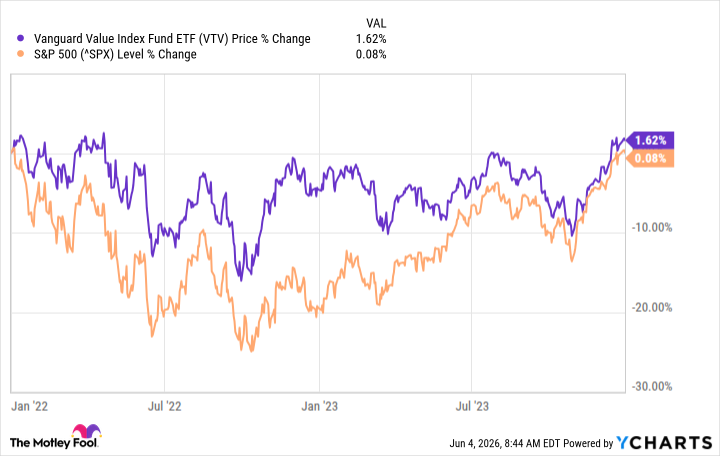
Investing isn't always about swinging for the fences -- sometimes, it's important to focus on capital preservation, particularly when uncertainty arises. Investors who are worried about the sustainability of the recent upside in the AI space might like the Vanguard Value ETF because of its performance during downturns. During 2022 and 2023, when soaring inflation and rising interest rates triggered volatility in the stock market, the Vanguard ETF returned 1.6%, while the S&P 500 was flat.
Data by YCharts.
But more importantly, the S&P fell by over 20% during that window, which constituted a technical bear market, whereas the Vanguard ETF suffered a lesser decline of 18% at its lowest point. Not all market downturns are the same, but if the next one is sparked by a reversal in the AI industry, I would expect the Vanguard ETF to fare even better on a relative basis because of its low exposure to tech.