Vanguard is known for offering broadly diversified low-cost index funds that let you own hundreds or thousands of stocks. But for investors who want to make a more concentrated investment in growth stocks, Vanguard has choices.
Two popular Vanguard growth exchange-traded funds (ETFs) offer slightly different mixes of U.S. growth stocks, with a big emphasis on tech stocks. The Vanguard S&P 500 Growth ETF (VOOG -0.26%) holds 145 stocks, and its tech sector weighting is 49.2%. The Vanguard Mega Cap Growth ETF (MGK -0.24%) is even more concentrated: It holds 59 stocks, and 70% of the fund's assets are in the tech sector.
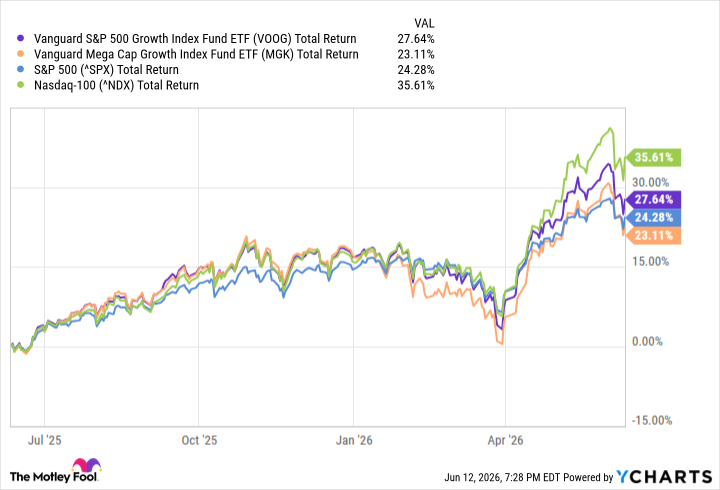
In the past year, the Vanguard S&P 500 Growth ETF has outperformed the S&P 500 index, while the Vanguard Mega Cap Growth ETF has slightly underperformed. But the tech-heavy Nasdaq-100 index has outperformed both Vanguard growth funds. Let's see which of these two Vanguard growth ETFs could be the better buy.
VOOG Total Return Level data by YCharts
VOOG vs. MGK: Head-to-head comparison
Both Vanguard ETFs charge low fees (their expense ratios are 0.05% and 0.07%). But they have slightly different investing approaches that could make one a better fit for your portfolio. Here's a quick comparison:
|
Metric |
Vanguard S&P 500 Growth ETF (VOOG) |
Vanguard Mega Cap Growth ETF (MGK) |
|---|---|---|
|
Number of stocks |
145 |
59 |
|
Top five sectors |
1. Information technology: 49.2% of the fund 2. Communication services: 17.6% 3. Consumer discretionary: 9.3% 4. Financials: 8.9% 5. Industrials: 6.7% |
1. Technology: 70% 2. Consumer discretionary: 14.9% 3. Industrials: 6.2% 4. Healthcare: 4.5% 5. Real estate: 1.30% |
|
Top five holdings |
1. Nvidia: 14.56% of the fund 2. Alphabet: 12.09% (combining Class A and Class C shares) 3. Microsoft: 9.09% 4. Apple: 5.98% 5. Broadcom: 5.94% |
1. Nvidia: 13.77% 2. Apple: 11.79% 3. Alphabet: 11.55% combining Class A and Class C shares 4. Microsoft: 8.69% 5. Broadcom: 5.2% |
|
10-year average annual total returns |
18.2% |
19.3% |
|
Expense ratio |
0.07% |
0.05% |
|
Price-to-earnings (P/E) ratio (as of April 30) |
31.8 |
35.4 |
Data source: Vanguard.
Both funds hold the same top five stocks, but in different amounts. The Mega Cap fund's objective is to get exposure to the largest U.S. growth stocks, so it's more top-heavy by necessity.
Why buy the Vanguard S&P 500 Growth ETF (VOOG)?
The Vanguard S&P 500 Growth ETF has slightly underperformed the Mega Cap fund for the past 10 years. However, it has a lower price-to-earnings (P/E) ratio (31.8). This could mean the S&P 500 Growth fund is a little cheaper than the Mega Cap fund, which is more highly concentrated in high-valuation tech stocks.

NYSEMKT: VOOG
Key Data Points
Ten years of 18.2% annualized returns is nothing to sneeze at; that's much better than the stock market's long-term average of 10% returns per year. But this Vanguard fund feels like an oddly sized portfolio. If you want to invest heavily in "only" 100 or so tech stocks, buying the Invesco QQQ ETF (QQQ +0.05%) could be a better choice. That ETF lets you own the entire list of companies in the tech-heavy Nasdaq-100 index -- and it's delivered 10 years of annualized returns of 21.8%.
Why buy the Vanguard Mega Cap Growth ETF (MGK)?
Because it holds only 59 stocks, the Vanguard Mega Cap Growth ETF is more of an all-in bet on major tech names. However, this concentrated bet seems to be paying off, for now. The Mega Cap Growth fund has outperformed the other Vanguard ETF and the S&P 500 for the past 10 years, with an annualized return of 19.33%.

NYSEMKT: MGK
Key Data Points
This fund also has a slightly higher beta (and is therefore more volatile) than the S&P 500 Growth fund. The Mega Cap Growth fund has a beta coefficient of 1.13 relative to the Dow Jones U.S. Total Stock Market Index, while the S&P 500 Growth fund has a beta coefficient of 1.10. That beta metric could be a reason to buy the Mega Cap Growth fund, because it's only slightly more volatile while delivering higher returns.

Image source: Getty Images.
Why buy one instead of the other?
I don't own either of these funds, and neither one made the list of best Vanguard ETFs. But if I had to choose one, I would go with the Vanguard Mega Cap Growth ETF. Usually, I prefer more diversified ETFs with a higher number of stocks; when in doubt, more stocks tend to beat fewer.
However, I'm breaking that rule in this case. Because these funds are so similar, with the same top five holdings and nearly identical levels of volatility, I believe that the more concentrated portfolio of the Mega Cap Growth ETF could have a better chance of future outperformance, without much additional risk.
If you want to invest in a top-heavy, tech-focused growth ETF, your best choice might be the Invesco QQQ ETF. But if you must choose between these two Vanguard growth ETFs, you might as well go with the fund that is a higher-conviction play.