The next Federal Reserve meeting is on Wednesday, Sept. 16, and it could be a doozy because the central bank could deliver its first interest rate hike in more than three years. Many professional investors believe that will happen as Fed funds futures implied a 59.4% chance of a rate increase as of Sept. 4.
Inflation tells the tale of why a hawkish stance is very much on the table for the Fed. While headline inflation is expected to cool this month, a deeper dive reveals that Core Personal Consumption Expenditures (PCE) are climbing. That gauge, which is a preferred tool of the Federal Open Market Committee (FOMC), strips out volatile energy and food prices, implying that consumers are paying higher prices for an array of goods beyond gas and groceries.

This healthcare could be just what the doctor ordered if interest rates rise. Image source: Getty Images.
So it's not a stretch to say that the Fed's hand may be forced and that a rate hike is imminent. Investors may find some rate-hike protection in healthcare stocks and exchange-traded funds, such as the State Street Health Care Select Sector SPDR ETF (XLV +0.07%).
XLV's relevancy then and now
Time will tell whether the Fed merely nudges rates higher once or twice, or embarks on a rate-tightening regime à la 2022-23. Ideally, it's not the latter, but if it is, this healthcare ETF has a favorable recent history. When the Fed began raising interest rates in 2022 to curb inflation, the S&P 500 tumbled 18.6%, while this healthcare ETF lost just 1.1%.
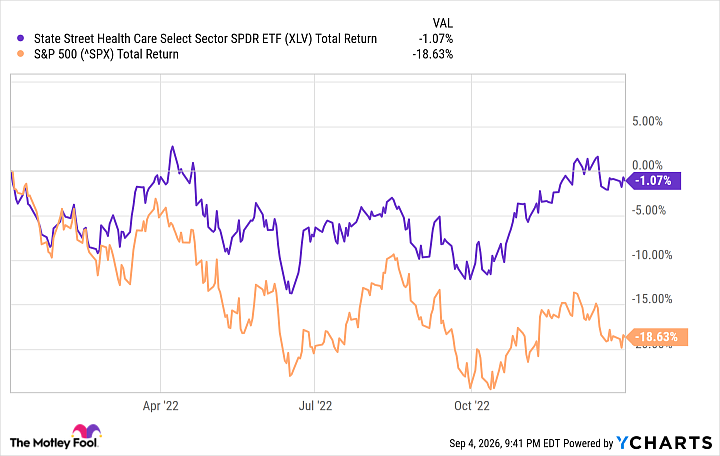
XLV Total Return Level data by YCharts
The $45 billion healthcare ETF's history against the backdrop of Fed tightening is relevant here and now because of some wonky correlation stuff. Put simply, the correlation between equities and 10-year Treasury yields is now negative, indicating that Mr. Market is walking on sticky inflation eggshells.
Defensive sectors, including healthcare, have a history of proving durable or less bad when the aforementioned "correlation conundrum" appears. One reason is that those groups are chock-full of dividend-paying stocks, which can serve as a buffer when broader benchmarks slip. For its part, the SPDR ETF carries a 30-day SEC yield of 1.47%.

NYSEMKT: XLV
Key Data Points
The ETF is home to four Dividend Kings -- those companies that have raised payouts in 50 consecutive years -- three of which are among the fund's top 10 holdings. That trio is led by Johnson & Johnson, which is the healthcare ETF's second-largest component.
Inflation backs the case for this ETF
Some certainties make the SPDR ETF a smart idea this month. First, new Federal Reserve Chair Kevin Warsh is eager to ward off inflation. Second, larger, higher-quality healthcare stocks tend to be somewhat insensitive to rate hikes while still generating solid earnings when Fed hawkishness cools economic growth.
Another certainty is that Fed rate actions, be they cuts or increases, take time to work their way through the economy. That is to say, a rate hike could arrive this month, but its inflation-cooling effects may not be felt for months. If that proves to be the case, the healthcare sector's reputation for growing earnings in inflationary environments becomes all the more coveted, underscoring why some experts call the group the "antidote" for inflationary times.
So the State Street Health Care Select Sector SPDR ETF isn't a cure for undesirable monetary policy, but it is a smart investment when rates rise.