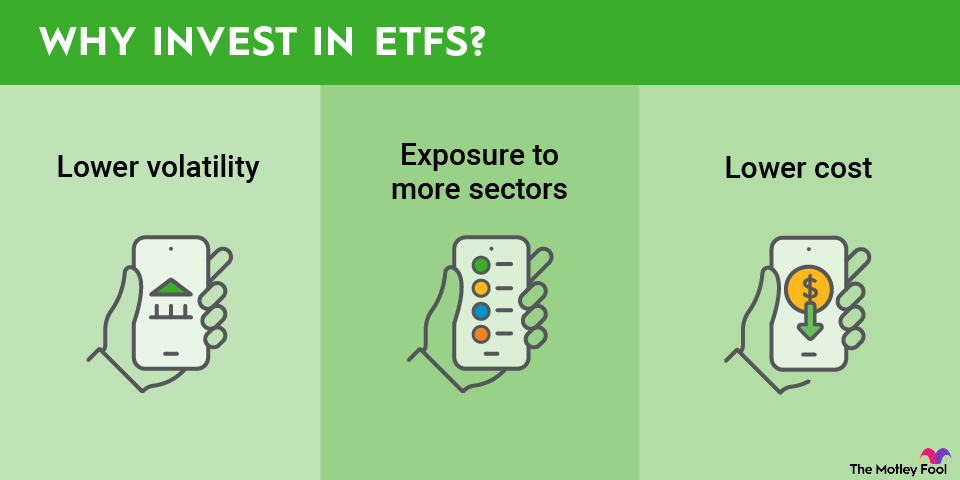
One of my favorite (and most recommended) ways to invest is through exchange-traded funds (ETFs) because they can fulfill multiple investment criteria all at once. ETFs may have a lower chance of generating life-changing gains that individual stocks occasionally offer. But they usually involve much less risk, which doesn't mean sacrificing gains.
A great growth ETF to invest in is the Vanguard Morningstar Growth ETF (VUG -0.36%). It's the seventh-largest ETF in the world as measured by assets under management, and its historical returns make it easy to see why investors gravitate toward it. It's not a get-rich-quick investment, but you can invest $500 monthly in VUG and be well on your way to an $800,000 nest egg in roughly 25 years.

Image source: Getty Images.
How VUG is constructed
VUG holds 147 large-cap growth stocks covering all sectors, but it is heavily concentrated in tech. Here's how its allocation breaks down by sector:
- Technology: 69.8%
- Consumer Discretionary: 13.7%
- Industrials: 7.3%
- Healthcare: 4.5%
- Telecommunications: 1.5%
- Financials: 1.3%
- Real Estate: 1%
- Basic Materials: 0.4%
- Energy: 0.3%
- Consumer Staples: 0.2%
- Utilities: 0.1%
To fit the "growth" label, a company should grow its revenue and profits faster than the broader market average, and right now, many large tech companies do. Still, it's nice to have representation from other sectors (however small) to help diversify and cushion potential blows to the tech sector.
One thing to note, though, is that Nvidia, Apple, and Microsoft alone account for over 36% of VUG. That isn't ideal for diversification, but those companies are likely to thrive long term, adding some stability. If you're investing in VUG for the long haul (which you should be to hit the $800,000 mark), you want growth companies, but it also helps if they're established industry leaders.

NYSEMKT: VUG
Key Data Points
The math behind $800,000
Since it began trading in January 2004, VUG has averaged 11.1% annual returns and 12.3% annual total returns (including reinvested dividends). Past results don't guarantee future performance, but if VUG were to continue averaging 12% annual total returns, here's roughly how much $500 monthly investments could grow to over different numbers of years:
| Years Invested | Total Return Value |
|---|---|
| 10 | $105,200 |
| 15 | $223,600 |
| 20 | $432,300 |
| 25 | $800,000 |
| 30 | $1.44 million |
Table by the author. Calculations via Investor.gov. Invested values are rounded down to the nearest hundred.
In this example, you can reach $800,000 in 25 years while investing only $150,000 personally over that period. That's the power of time and compounded returns. Even if VUG averaged a more conservative 10% annual return, $500 monthly could grow to over $590,000 in 25 years.
Real-world amounts will inevitably vary, but the bigger point is that consistently investing in VUG (or any investment) can pay off nicely over time. It's not as glamorous as finding "the next big thing," but it works very well.