For years, AI data centers have almost exclusively relied on GPUs for all AI processing and learning. But as tech companies have deployed more advanced models and AI agents become prolific, custom processors have become increasingly important. That's because custom processors can be fine-tuned to run specific AI models for agents faster and more efficiently than general GPU processors for some tasks.
And some of the biggest winners in this space are custom chip designers Broadcom (AVGO -3.10%) and Marvell Technology (MRVL -8.72%), as well as the world's leading processor manufacturer, Taiwan Semiconductor Manufacturing (TSM -3.40%).
Here's why their position in the custom processor space matters, as Alphabet (GOOGL -1.74%) (GOOG -1.68%), Microsoft, Amazon, and other companies spend hundreds of billions on this expanding market.
Image source: Getty Images.
In-house custom chips are rising in popularity
To understand why tech companies need customer processors, it's important to know that many of them rent out cloud computing processing and AI services to customers.
For example, Alphabet's Google Cloud business includes everything from cloud computing to its Gemini Enterprise subscriptions. Sales from this segment soared 82% in the second quarter to $24.8 billion, making it Alphabet's fastest-growing revenue segment.
To offer some of the best AI services to its cloud customers, Alphabet leans on its own custom-designed Tensor Processing Units (TPUs). Just a few months ago, the company signed a multiyear deal with Broadcom for custom processors through 2031.
The financial details of the agreement weren't released, but it's certainly helping to accelerate Broadcom's sales of custom processors. Management says revenue from AI semiconductors will reach $56 billion this year and soar to more than $100 billion next year.

NASDAQ: AVGO
Key Data Points
Marvell is tapping into the custom chip space, too. The company is a custom chip designer for Amazon's Trainium and Microsoft's Maia AI processors. That's notable because Amazon and Microsoft are the two leading cloud computing platforms, and Microsoft's popular Azure just surpassed $100 billion in annual revenue for the first time, thanks to rising AI compute demand.
Marvell also just secured a $2 billion investment from Nvidia (NVDA -3.16%), which gives Nvidia's customers access to Marvell's custom processors. This shows just how intertwined the AI processor market is now, and how customer AI processors can work alongside traditional GPUs for AI compute.
While Nvidia benefits from including Marvell's custom chips in its network offerings, the rise of custom AI processors could eventually erode Nvidia's market share. The latest TrendForce data shows that custom processors will grow by an estimated 45% this year, while GPUs will rise by just 16%.
Still, traditional AI chip companies aren't going anywhere anytime soon. Advanced Micro Devices (AMD -5.73%) recently won a massive deal with Meta worth up to $60 billion, and has AI compute agreements with OpenAI and Anthropic. Demand for AMD's processors resulted in the company's sales rising 50% to $11.5 billion in the second quarter and non-GAAP (generally accepted accounting principles) earnings per share soaring 246% to $1.66.

NASDAQ: MRVL
Key Data Points
One company benefits no matter how all of this goes
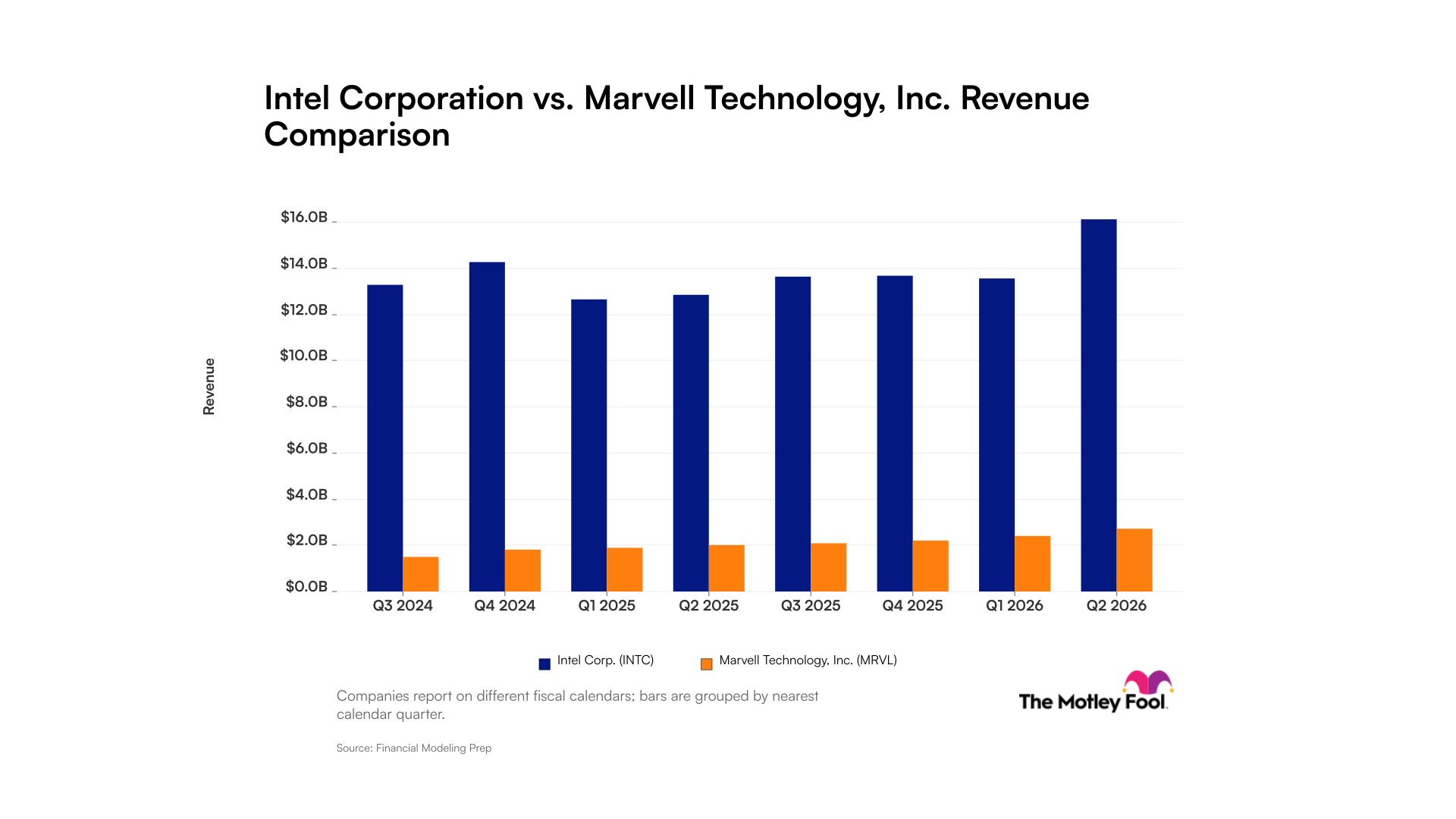
Some investors will no doubt wonder where Intel (INTC -4.56%) fits into this surge in demand for processors, especially considering its investments from the U.S. government and Nvidia. But while its share price has soared 188% over the past year, analysts estimate its sales will rise by just 15% next year.
Intel has secured major deals, including with Space Exploration Technologies and Tesla, to help manufacture chips for its Terrafab data center project. But Intel's overall success is still very much up in the air, considering its foundry business lost $2.1 billion in the second quarter -- and just $293 million of its sales came from outside customers.
Rival Taiwan Semiconductor, also called TSMC, is doing much better. TSMC manufactures about 73% of the world's processors, and an estimated 90% of the most advanced processors -- custom or otherwise.

NYSE: TSM
Key Data Points
This means that no matter how many GPUs Nvidia and AMD sell, or whether Broadcom's and Marvell's custom processors expand further into the AI processor market, TSMC will benefit. The company's second-quarter sales were up 36% to over $40 billion, and non-GAAP diluted earnings popped 77% to $4.31 per American depositary receipt (ADR).
For investors looking for a custom AI processor play, TSMC, Broadcom, and Marvell are the best bets. Of the three, Broadcom could have the most potential to benefit, as its sales and earnings are increasing faster than those of TSMC and Marvell.
What's more, Broadcom's stock has a forward price-to-earnings ratio of just 19, making it far cheaper than the broader tech sector and a relatively good bargain.