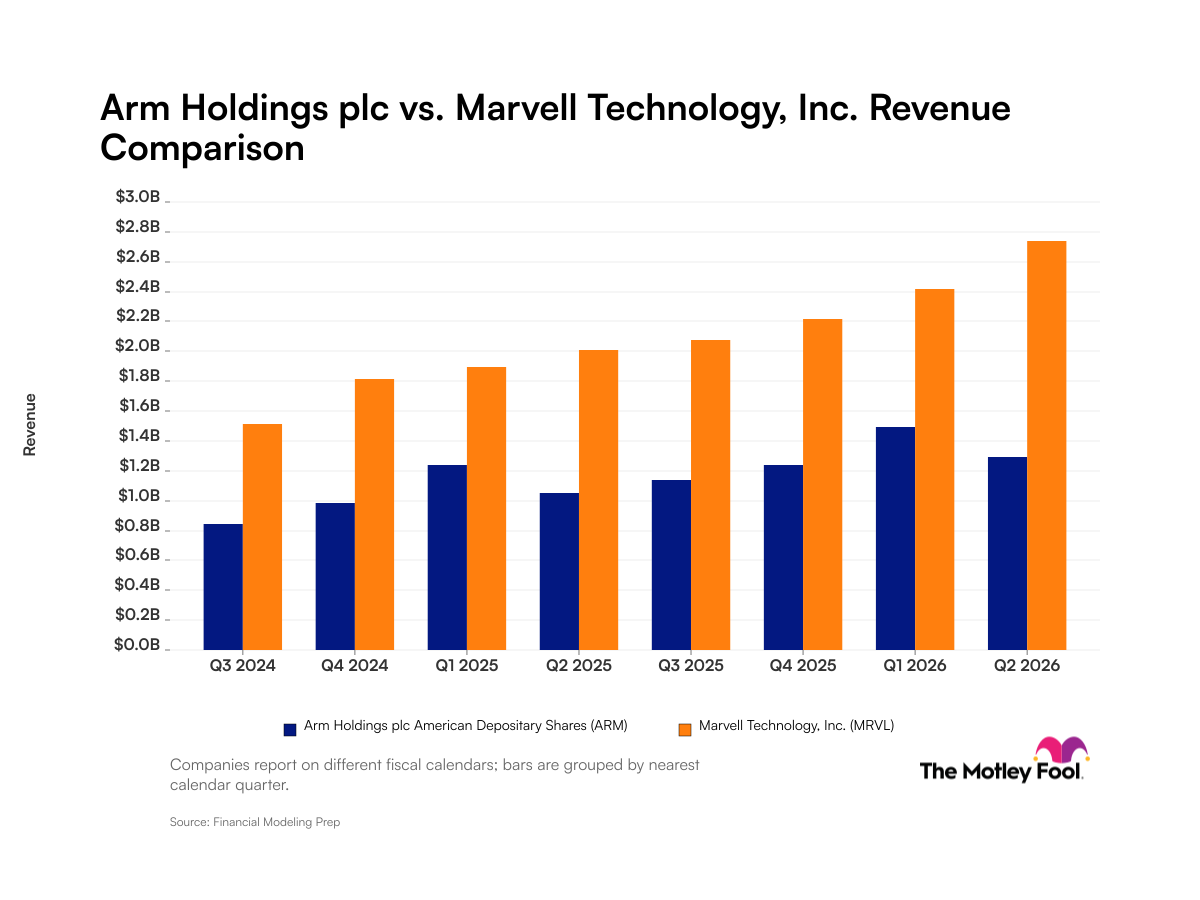
Many Nvidia (NVDA -0.50%) investors warily monitor Advanced Micro Devices (AMD -3.44%) and Broadcom (AVGO -2.06%). And for good reason. AMD competes directly with Nvidia. Broadcom co-develops custom silicon for companies such as Alphabet's (GOOG -0.54%) (GOOGL -0.75%) Google to help them reduce their dependence on Nvidia.
However, there's another chip designer that Nvidia investors should be watching closely. This company isn't even really a rival to Nvidia. But without it, Nvidia is unlikely to be successful going forward.
Image source: Getty Images.
A lucrative Nvidia connection
I won't try to build the suspense: The chipmaker I'm referring to is Arm Holdings (ARM -3.59%). In some ways, Arm ranks as the most important semiconductor stock other than Nvidia itself.
Arm's business model makes it unique from AMD, Broadcom, and other chipmakers. The company licenses its architecture, then collects royalties on every chip manufactured using its designs. Some have described the ongoing intense competition between semiconductor makers as the "chip wars." By that analogy, Arm is the top weapons supplier to many major combatants.
Nvidia is a key customer for ARM. The Vera CPUs built to run agentic artificial intelligence (AI) are built on Arm's architecture. When Nvidia recently projected a stunning $20 billion in Vera CPU sales by the end of the current fiscal year, it was understandably great news for Arm.
Arm has already made a huge inroad into the data center CPU market, though. Its customers include the big three cloud providers -- Amazon (AMZN -0.66%), Microsoft (MSFT -0.66%), and Google. Arm executive vice president Mohamed Awad recently told Nikkei Asia in an interview that his company has captured "over 50%" of the hyperscaler market, adding, "The tailwinds are running with us."
An impressive growth trajectory
Throughout most of this year, Arm's stock outperformed nearly every other semiconductor stock. It's still handily beating Nvidia and Broadcom, although a recent pullback now has Arm trailing behind AMD.
ARM Arm Holdings
NASDAQ · As of 9:40 AM ET 10/16/26

This stock performance is backed up by strong financial growth. Arm's revenue jumped 22% year over year in the first quarter of its fiscal year 2027 to a record high of roughly $1.3 billion.
Royalty revenue comprised around 55% of that total, reaching $715 million. This bodes well for Arm going forward. When royalties from chips sold that use its architecture generate more revenue than upfront licensing deals, the company's revenue stream is more predictable.
Don't think Arm's licensing momentum is waning, though. Licensing and other revenue increased 23% year over year in fiscal Q1 to $574 million. Management said this growth was "driven by continued strong demand for Arm IP [intellectual property]."
Is Arm stock a buy?
Regardless of which company wins the smartphone and AI chip races, Arm benefits. All the top competitors in these markets use Arm's architecture -- and pay royalties for the privilege. Not even Nvidia, the largest technology company on the planet based on market cap, can make that claim.
Does this make Arm stock a no-brainer buy? Not quite. There's one nagging little detail about Arm that investors can't ignore: its steep valuation.
Arm's shares currently trade at more than 150 times forward earnings. Nvidia, AMD, and Broadcom look dirt cheap by comparison. For that matter, so does every other large-cap stock that operates in the semiconductor industry.
Normally, that kind of nosebleed-level valuation would send analysts headed for the hills. Wall Street remains bullish about Arm, though. Of the 22 analysts who have rated the stock over the past three months, 17 recommended buying it. The consensus 12-month price target reflects a potential upside of roughly 19%.
This enthusiasm among analysts underscores the critical role that Arm plays in the chip market. Arguably, no company is more aligned with Nvidia's growth than Arm. Investors must pay a lofty premium to own this stock, but sometimes that premium is worth it.