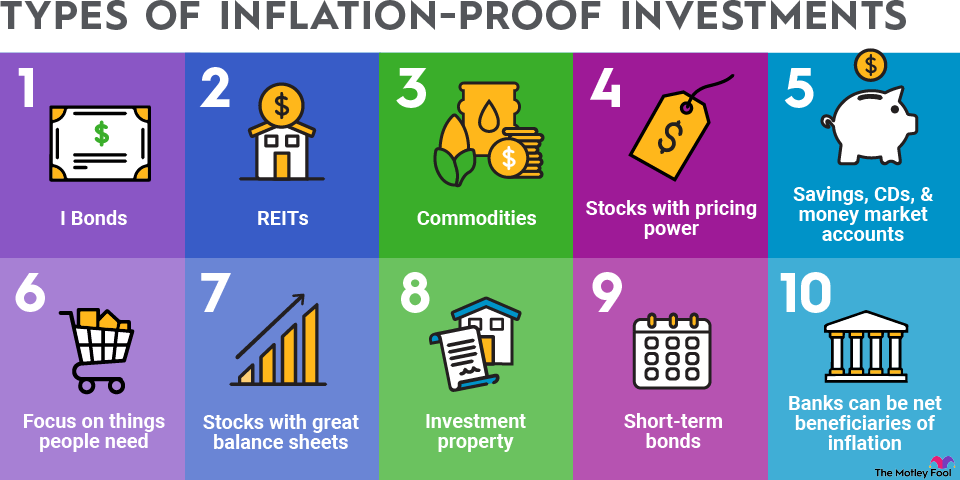
8. Investment properties
Owning an actual investment property isn't for everyone. Even if you hire a property manager, owning real estate is a more hands-on type of investment than buying REITs or other stocks.
However, rental properties can be an excellent way to build wealth over time and can protect against inflation. Historically, both home prices and rental rates have kept pace with inflation -- or slightly more -- over long periods of time.
9. Short-term bonds
Short-term bond investments are typically less price-sensitive than long-term bonds and pay more in inflationary periods. Let's say you bought a 30-year Treasury bond paying 2.5% interest a couple of years ago. If the yield on new 30-year Treasuries rises to 4%, your bond becomes intrinsically less valuable. You'll still collect your interest payments (at the 2.5% rate), but the market value of the bond -- if you need to sell it -- will drop significantly.
On the other hand, you don't see the same price fluctuations in short-term bonds. As of March 2026, the one-year Treasury yield was about 3.55%. If interest rates were to rise, it wouldn't have much of an effect on your bond's value since it's already so close to maturing.
10. Banks as net beneficiaries of inflation
Elevated inflation can certainly be a negative for bank stocks, as it can lead to lower loan demand and an uptick in consumer defaults. But there's also another side to the story.
Inflation usually leads to rising interest rates (as we've seen over the past year or so), which can boost banks' profits. After all, the core business of banks is to take deposits and lend the money, collecting interest. This can be a particularly significant benefit for the largest banks, which tend to pay low deposit rates even in higher-rate environments.
How inflation may impact different investment types
As we've discussed throughout this article, inflation can impact different investments in different ways. With stocks, there is a wide range of inflation impacts and sensitivities. Some sectors and industries tend to get hit harder by inflation than others, such as real estate.
Outside of stocks, there are some types of investments with clearer inflation impacts:
Bonds: Rising inflation makes existing bonds worth less, as yields on newly-issued bonds increase. For example, if the 30-year Treasury rate rises to 5%, an existing 30-year Treasury with a 4% yield is less valuable to a prospective investor.
Real estate (properties): Real estate is generally a solid hedge against inflation, as home values and the rental income generated by investment properties tend to rise over time in line with inflation.
Precious metals: Gold and silver are often considered hedges against inflation, though the relationship isn't perfect. Over time, however, precious metals tend to keep pace with inflationary pressures.
Building an inflation-resistant portfolio
To be perfectly clear, if your goal is to build an inflation-resistant portfolio, you don't have to invest only in the things on this list. But by incorporating them into a diversified investment strategy, you can prepare your portfolio to not only weather the effects of inflation but also come out even stronger on the other side.
Common mistakes and myths about inflation investing
There are some common misconceptions about inflation that can lead to mistakes for investors. So, let's take a minute to clear them up:
- Inflation is always bad: This is 100% false; in fact, manageable inflation is widely considered good for the economy. In fact, the Federal Reserve sets its monetary policy with a 2% inflation target in mind, and if it gets too far below that, it has been known to adjust accordingly.
- Inflation causes recessions: To be sure, out-of-control inflation is no good for the economy and can certainly lead to recessions as consumers pump the brakes on spending. But that isn't always the case. There have been many examples throughout history, including as recently as 2009, where a spike in inflation immediately preceded a bull market. So, don't think you need to get out of stocks just because inflation is elevated.
- Inflation is caused by corporate greed or government policies: Here's one big takeaway. There is no single factor that causes inflation. There are many factors that may be operating simultaneously, and every inflationary period has a unique set of causes.
Long-term perspective on inflation and investing
Over time, the stock market tends to handily beat inflation. In fact, over periods of several decades, the S&P 500 has historically delivered average returns of 9%-10 %.
Having said that, there are some principles that you can use to set yourself up for long-term success regardless of what the inflationary environment does:
- Invest in companies with pricing power, as they tend to better protect their margins during periods of high inflation than most.
- Real assets (investment properties, land, etc) tend to rise in value along with inflation.
- TIPS (Treasury Inflation-Protected Securities) and Series I Savings Bonds (I Bonds) can help protect the fixed-income portion of your portfolio from inflation risk.
- Companies with excellent histories of increasing their dividends every year can help you create an income stream that rises faster than inflation over time.
- While it's smart to keep some cash on hand, avoid keeping too much cash, as inflation will erode its purchasing power over time.
- Diversifying internationally can be a smart strategy to hedge against the effects of inflationary environments in the United States.