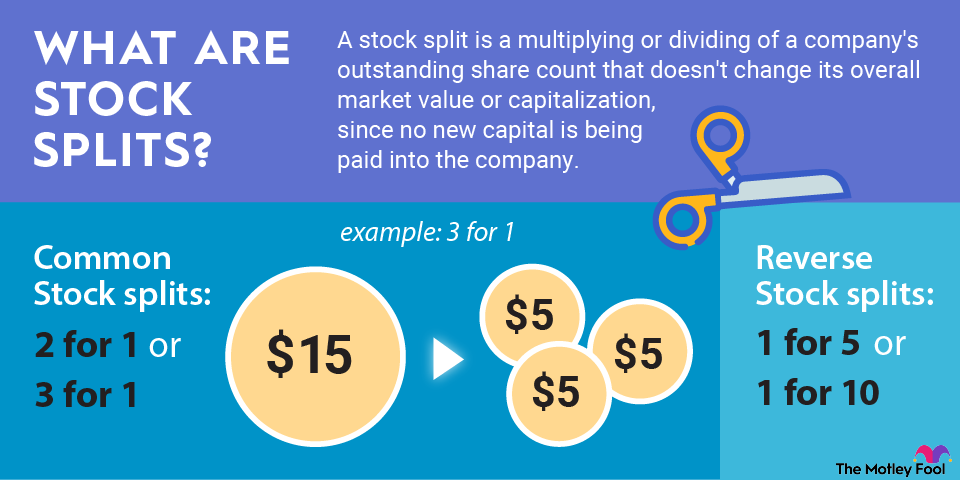
A stock split refers to when a company divides each of its existing shares into a different number of shares. When a company decides to split its stock, it can generate significant excitement. For example, in a stock split, you might get three shares for every one that you already own.
A stock split occurs when a company increases its number of shares outstanding by dividing existing shares, multiplying the share count, and reducing the share price to compensate. A stock split lowers share prices but doesn't change a business's fundamental value or the total value of the shares owned by shareholders.
Stock splits in a growing business often attract significant attention from retail investors. For example, after Nvidia's (NVDA +1.80%) 2024 stock split was announced, its stock price surged higher.
How a stock split works
When a company decides to split its stock, it typically issues a press release that outlines the key details of the split. For example, this will include the ratio of the stock split (i.e., how many shares you'll receive for each one you own), as well as the effective date of the split, which is when the stock will begin trading on a split-adjusted basis.
On the effective date of a stock split, the share price will be proportionately reduced, and the additional shares will be credited to investors' accounts. If the company completes a 10-for-1 stock split, and you owned 20 shares worth $1000 each prior to the split, you would now own 200 shares worth $100 each.
Upcoming and recent stock splits
As of this writing in March 2026, there are a few high-profile stock splits that have been announced recently.
- The most recent notable split, and the only major one still outstanding as of this writing, is Booking Holdings (BKNG +1.76%), which announced a 25-for-1 stock split. The split is scheduled to take effect after the market closes on April 2, 2026, and trading will begin on a split-adjusted basis on April 6. The stock trades for about $4,250 as of this writing, so the split may have been necessary to keep its stock accessible to retail investors.
- Artificial intelligence (AI)-focused workflow software company ServiceNow (NOW +0.52%) recently had a 5-for-1 split approved by its shareholders, which went into effect in mid-December. The goal of the split was to lower the per-share price, making the stock more accessible to individual investors.
- Streaming video giant Netflix (NFLX +1.69%) completed a 10-for-1 stock split in mid-November 2025, which reduced the share price from more than $1,000 to just over $100. This also made the stock more accessible to retail investors after years of incredible stock performance.
Possible 2026 stock splits
There has been speculation that megacap technology stocks could announce stock splits of their own in the near future, but they haven't done so yet. Other stocks to watch for that could possibly split in 2026 or soon after include:
- Credit rating and financial analytics company Fair Isaac (FICO -5.77%) hasn't split its stock since 2004. More than 20 years later, its shares were trading for around $1,800 in December 2025.
- Microsoft traded for about $475 per share in December 2025, which is a fraction of the price of the other two stocks on this list. However, the company has a history of splitting its stock and could be especially inclined to do so since it's part of the price-weighted Dow Jones Industrial Average.
Why companies do stock splits
Stock splits (as well as reverse stock splits) typically don't change a company's fundamental value. They also don't change an investor's ownership stake in the company. For example, if you own a slice that is one-quarter of the whole pie, cutting it into smaller pieces doesn't change the fact that you still have one-quarter of the total pie.
Since a stock split doesn't really fundamentally change anything, why would a business choose to do one? Often, it is related to attracting new investors. A lower price per share attracts many individual investors to a popular company.
Additionally, many publicly traded companies give employees an ownership stake in the business by granting them stock-based compensation. A lower share price can help a business manage the benefits issued to its employees.
Also, many companies repurchase shares as part of a return on investment to existing shareholders. A lower share price can help a company manage the purchases and returns to investors.
Take Amazon (AMZN +2.33%) as an example. In its 2022 stock split filing, the company stated, "The stock split would give our employees more flexibility in how they manage their equity in Amazon and make the share price more accessible for people looking to invest in the company."
Should you buy a stock because of an upcoming split?
If you are a long-term investor who plans to own shares of a company for at least a few years, an upcoming stock split is no reason to buy an ownership stake in a business. A company generally has good reasons for initiating a split, but it doesn't change the fundamental value for shareholders.
Rather, look for companies benefiting from long-term secular growth trends, growing faster than their peers, and with healthy profit margins and balance sheets.
How does a stock split affect your portfolio?
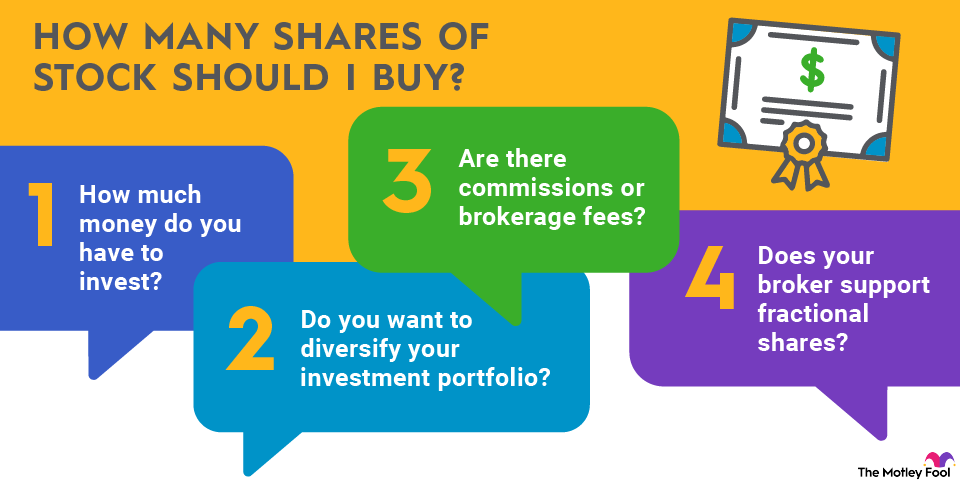
For the most part, the only changes you'll notice when a stock splits are that the share price will fall and the number of shares you own will climb.
There are a couple of other ways a stock split could impact you, especially if you're an options trader. For example, you generally need 100 shares of stock to write a covered call on a position. If you own 50 shares of a stock that splits two-for-one, writing call options now becomes a possibility.
FAQ
Upcoming stock splits FAQ
About the Author