Compound Interest
Interest Rate
Savings Account
About the Author
The Motley Fool has a disclosure policy.
Invest better with The Motley Fool. Get stock recommendations, portfolio guidance, and more from The Motley Fool's premium services.

Compound interest is undoubtedly the most important concept to understand when building wealth for the long term. Here's a closer look at how compound interest accounts work.
When you put money in an account that pays interest, the interest payment stays in the account. As a result, the amount earning interest grows with each new interest payment.
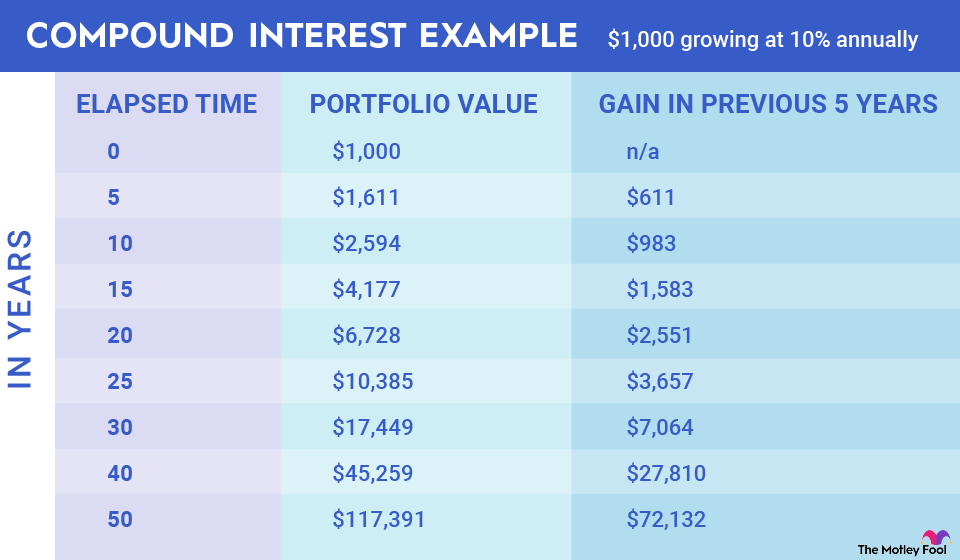
It's a relatively simple concept, but one with mind-blowing possibilities. The longer you let your investments sit, the more rapidly they grow. Consider a single $1,000 investment growing at 10% annually:
Notice that over the first five years, the $1,000 investment grows by $611. But decades later, without any additional investment, that sum is growing by tens of thousands of dollars over the same number of years.
Now, imagine what would happen if you were to start with $5,000 or $10,000, keep contributing more money to your account regularly, and make smart investment choices to increase your returns.
Compound interest includes interest earned on previously generated interest. Simple interest is just the interest rate multiplied by the investment or principal amount.
Simple interest is often used in a loan or bond context where the interest is the same every period and there is no compounding. Compound interest is used in investment and savings contexts.
The simple interest formula is:
This means the account value (A) is equal to the original investment amount (P) times 1 plus the rate (R) multiplied by the time (T).
Let's go over the compound interest formula and define each variable.
Let's say you invested $10,000 in a savings account that pays 5% interest, compounded monthly. After five years, you would calculate the savings amount like this:
When it comes to investing strategies, you have several options for taking advantage of compound interest to build wealth.
Savings accounts: Banks lend out the cash you put into a savings account and pay you interest in exchange for not withdrawing the funds. Savings accounts that compound daily, as opposed to weekly or monthly, are the best because they increase your balance faster. You can open a savings account with any local or online bank.
Money market accounts: These are almost the same as savings accounts except they allow you to write checks and make ATM withdrawals. Money market accounts often pay slightly higher interest rates than savings accounts do. However, most money market accounts limit your monthly transactions, and some charge a fee if your balance falls below a certain amount.
Certificate of deposit (CD): A CD requires you to lock your money up with a bank for a specified time (typically six months to five years). In exchange, you'll get a guaranteed interest rate on your money. The interest payments accrue in the account, compounding over the life of the CD.
Savings bonds: Both the Series EE and Series I savings bonds issued by the U.S. Treasury earn interest monthly. That interest compounds every six months, meaning the interest earned over the previous six months is automatically added to the bond's principal value and starts earning interest.
Generally speaking, if you stay within Federal Deposit Insurance Corp. (FDIC) limits, both savings and money market accounts are extremely safe options. They became even more attractive when interest rates rose quickly in 2022 and 2023, though rates have cooled off a bit since then.
To profit significantly from compounding interest, it's important to diversify your money with different types of accounts and investments.
There are a few factors to consider when looking at various accounts and account types.
While compound interest can provide consistent and safe returns for investors, you can get better returns over the long run by investing in other assets. In particular, dividend stocks and real estate investment trusts (REITs) offer consistent cash flow while providing additional upside in capital appreciation.
Stocks that pay dividends compound similarly to compound interest if you reinvest the dividends. You can instruct your brokerage to automatically reinvest all dividend payments you receive and buy more shares.
The risk, however, is that the share price will decline by more than the dividends received. A good dividend stock will, over the long run, provide both capital appreciation and a bigger dividend payment.
A REIT is an entity that holds a portfolio of real estate or real estate loans. Either strategy can produce consistent cash flow, which a REIT is required to pass on to its shareholders. That means shareholders receive sizable distribution checks every year and can reinvest them in the REIT to compound over time.
Compound interest can turn meager investments into wealth over time, especially if you start investing as soon as possible and stay invested. The earlier you start investing, the more time you have for interest to compound.
The $1,000 investment in the example above increased by $983 from the fifth year to the 10th year and by $7,064 from year 25 to year 30. The longer you wait to start investing, the older you will be when you reach year 30.
Staying invested is key to maximizing the effects of compound interest. If you're constantly moving or withdrawing your money, you lose out on a lot of potential compounding.
There are plenty of good reasons to withdraw your savings, though. You could have reached your savings goal and now need to spend the cash. Or you could be moving from a compound interest account to a riskier investment, like stocks or real estate, which have more attractive return potential.
But heed Charlie Munger's wisdom: "The first rule of compounding is to never interrupt it unnecessarily."