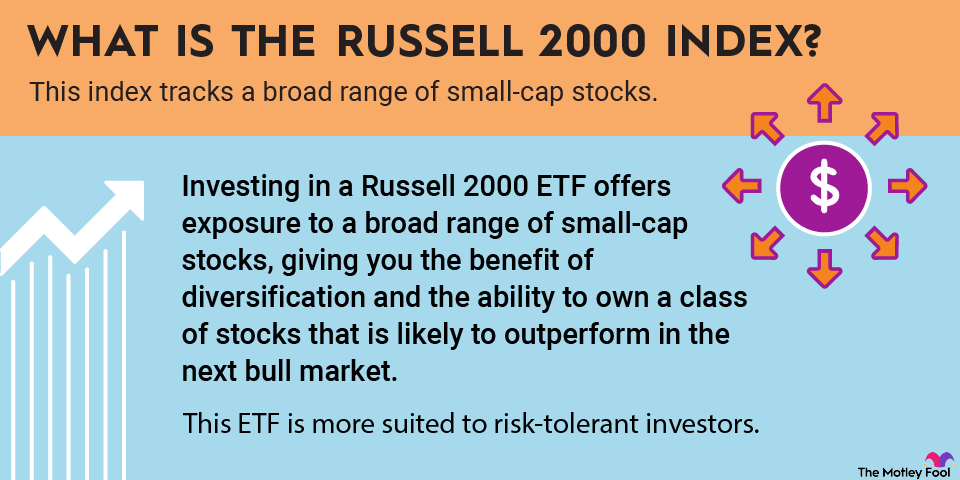
There are a number of reasons an investor would want to own a Russell 2000 ETF. The Russell 2000 index tracks a broad range of small-cap stocks, so if you want exposure to hundreds of small-cap stocks, the easiest way is with a Russell 2000 ETF.

The underlying index tends to be more volatile than other stock market indexes, such as the S&P 500, which tracks large-cap stocks. So, a Russell 2000 ETF is better suited to investors with a high risk tolerance. But with interest rates currently coming down, now could be an opportune moment to buy a Russell 2000 ETF since the index tends to do well when interest rates are falling.
In the article below, we'll discuss the key components of the best exchange-traded funds (ETFs) that track the benchmark Russell 2000, including their assets under management, expense ratios, investment results, unique aspects, and other attributes.
Top 5 Russell 2000 ETFs to consider
Name | Issuer | Assets Under Management | Expense Ratio |
|---|---|---|---|
iShares Russell 2000 ETF (NYSEMKT:IWM) | BlackRock | $73.7 billion | 0.19% |
Vanguard Russell 2000 ETF (NASDAQ:VTWO) | Vanguard | $14.3 billion | 0.07% |
Vanguard Russell 2000 Growth ETF (NASDAQ:VTWG) | Vanguard | $1.34 billion | 0.1% |
Vanguard Russell 2000 Value ETF (NASDAQ:VTWV) | Vanguard | $911 million | 0.1% |
Direxion Daily Small Cap Bull 3X Shares (NYSEMKT:TNA) | Direxion | $1.68 billion | 1.03% |
1. iShares Russell 2000 ETF

NYSEMKT: IWM
Key Data Points
2. Vanguard Russell 2000 ETF

NASDAQ: VTWO
Key Data Points
The Vanguard Russell 2000 ETF (VTWO +0.43%) is the best option if you're looking for a low expense ratio, as it charges only 0.07% of assets invested to participate in the fund. The ETF was started in 2010, and since then, its returns have mirrored those of the Russell 2000 index, up roughly 10% annually.
Its top holdings are similar to those of the iShares Russell 2000 ETF, with industrials as its biggest sector, accounting for almost 20% of its holdings. It also pays a slightly better dividend yield, at 1.16% as of Dec. 31, 2025, and is less concentrated in its top holdings than the iShares Russell 2000 ETF.
3. Vanguard Russell 2000 Growth ETF

NASDAQ: VTWG
Key Data Points

NASDAQ: VTWV
Key Data Points
5. Direxion Daily Small Cap Bull 3X Shares
Why you should consider a Russell 2000 ETF
There are a number of reasons why you might want to invest in a Russell 2000 ETF. Let's take a look at a few of them:
- ETFs can be a useful time-saver for investors, especially for a massive index like the Russell 2000. Researching and evaluating 2,000 small-cap stocks isn't realistic for most investors.
- ETFs also make it easy to diversify. A Russell 2000 ETF offers exposure across every stock market sector, though industrials tend to be the largest.
- A small-cap ETF can be a good choice for risk-seeking investors. Historically, the Russell 2000 has outperformed the S&P 500 during bull markets, and it tends to be more volatile and more sensitive to interest rates, rising when they fall.
- Most investors will have most of their stock investments in large-cap stocks. A Russell 2000 ETF provides a good way to diversify and get exposure to small stocks that you may not be familiar with.
Risks of investing in a Russell 2000 ETF
While there are benefits to investing in the S&P 500, there are also risks. These are some of the major ones:
- The Russell 2000 has historically been more volatile than the S&P 500, so a Russell 2000 ETF is riskier than an S&P 500 index fund , especially over the short term.
- The Russell 2000 tends to underperform the S&P 500 in bear markets as small caps are more exposed to bankruptcy and debt. Therefore, a Russell 2000 ETF can be a particularly bad investment in a bear market.
- The Russell 2000 has underperformed the S&P 500 over most recent timelines. While that's not guaranteed to continue, it does make the bar for investing in the small-cap ETF higher than it would be.
Important factors to consider when selecting a Russell 2000 ETF
If you're looking to invest in a Russell 2000 ETF, there are a number of factors you should consider.
First, determine your goal. If you're looking for growth, you'll want to invest in the Vanguard Russell 2000 Growth ETF. If, on the other hand, you're partial to value stocks, you'll probably want the Vanguard Russell 2000 Value ETF. Whether you choose growth or value will depend on your risk tolerance and other investing preferences.
If you want a balance between growth and value, you might consider an ETF like the iShares Russell 2000 or the Vanguard Russell 2000 ETF. On the other hand, if you're looking to make a short-term, leveraged bet, the Direxion Daily Small Cap Bull 3X Shares could be a good choice.
Before you choose your Russell 2000 ETF, it's worth asking why you want to invest in small-cap stocks. It could be because you are looking to diversify from the large-cap stocks found in the S&P 500, or you're anticipating that interest rates will fall and small-cap stocks will benefit. It may also be because small-cap stocks trade at a lower valuation.
Answering those questions will help determine which Russell 2000 ETF is the best for you.