Tech ETFs, or exchange-traded funds, are vehicles that allow you to invest in an entire basket of technology stocks in a single investment that trades just like a common stock. There have been some massive winners in the tech sector in recent years, but there has also been considerable turbulence.
Exchange-Traded Fund (ETF)
On the one hand, exciting new technologies like artificial intelligence (AI) have created many potential investment opportunities. On the other hand, stock market volatility makes many investors hesitant to pick individual tech stocks.

That's where exchange-traded fund (ETF) investing comes in. An ETF allows you to invest in a specific area of the stock market without the downsides of picking individual stocks.
There are several excellent ETFs that focus on either the overall tech sector or a specific part of it. These can provide exposure to the high-potential tech space in your portfolio but without the risks associated with investing in individual companies. In this article, we'll discuss seven top tech ETFs that are worth considering for investors looking to add diversified tech exposure to their portfolios.
Seven best tech ETFs
Let's take a closer look at each of these ETFs:
1. Vanguard Information Technology ETF
Vanguard is well-known for its low-cost index funds. The Vanguard Information Technology ETF (VGT -0.71%) certainly falls into this category, with a rock-bottom 0.09% expense ratio. This means that for every $10,000 you invest, your annual fund expenses are just $9. To clarify, an expense ratio isn't a fee you have to pay. It will simply be reflected in the ETF's performance over time.
This ETF tracks a broad index of U.S. tech companies of all sizes. However, it is a market-cap-weighted ETF, so its top holdings make up a larger proportion of its assets. In fact, the top three holdings account for 44% of the fund's total assets:
In short, the ETF is an excellent choice for investors who want a set-it-and-forget-it way to invest in the overall information technology sector.
Asset
2. Technology Select Sector SPDR ETF
The Technology Select Sector SPDR ETF (XLK -0.89%) is offered by State Street (STT +0.53%). It is very close to the Vanguard fund, offering a similar asset size, a low 0.08% expense ratio, and a similar benchmark index. In fact, the fund's top holdings (and their respective weights) are almost identical to the Vanguard example.
Both ETFs give you broad exposure to the information technology sector. It's tough to say which is better than the other. Investors who want to invest in tech stocks will not go wrong with either.
3. VanEck Semiconductor ETF
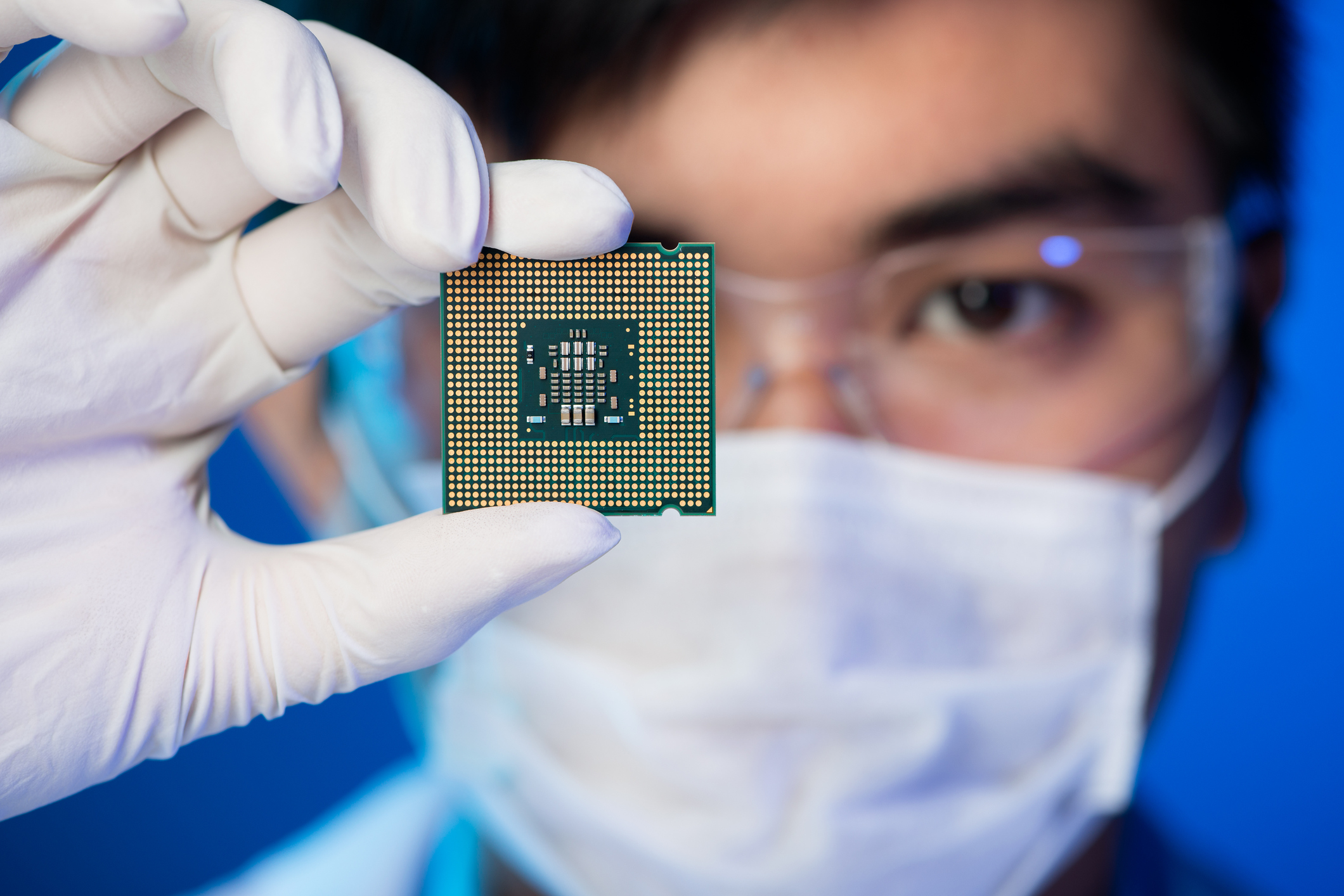
Now, we're getting into more specific ways to invest in tech stocks through ETFs. The VanEck Semiconductor ETF (SMH -1.97%) tracks an index of semiconductor manufacturers, commonly known as chipmakers. This can be an excellent way to invest in AI technology without having to buy individual stocks.
Semiconductor
Since this is a market-cap-weighted fund, Nvidia is the fund's top holding, making up about 19% of its assets. Other holdings include:
- Taiwan Semiconductor (TSM -2.45%)
- Broadcom (AVGO -1.30%)
- ASML (ASML -2.53%)
- Texas Instruments (TXN -1.04%)
- Applied Materials (AMAT -3.40%)
In all, there are 26 different chipmakers in the portfolio. The ETF has a slightly higher 0.35% expense ratio. However, it's important to note that investors should expect to pay a bit more for specialized ETFs like this.
4. iShares Cybersecurity and Tech ETF
It seems like there is another high-profile data breach every other week, and the sophistication of threats (especially in the cloud) is increasing. Investing in cybersecurity stocks can be an interesting opportunity for patient long-term investors. The iShares Cybersecurity and Tech ETF (IHAK +1.76%) lets you concentrate your money in this technology subsector.
The ETF has a 0.47% expense ratio, which is comparable to those of similar size and specialization. It aims to track an index of cybersecurity stocks and has 38 holdings. In addition to many other names you may recognize, top holdings include:
- Cyber Ark Software (NASDAQ:CYBR)
- Varonis Systems (VRNS +2.12%)
- CACI International (NASDAQ:CACI)
5. Invesco QQQ ETF
No discussion of tech ETFs would be complete without mentioning the Invesco QQQ Trust (QQQ -0.00%). It is by far the largest Nasdaq-tracking ETF. The QQQ ETF has a relatively low 0.18% expense ratio and tracks the Nasdaq-100 index, which is essentially an index of the largest stocks listed on the Nasdaq exchange.
To be perfectly clear, the QQQ ETF isn't a pure tech ETF; it is just very tech-heavy. More than 60% of the fund's assets are invested in the technology sector. Top positions include:
The Invesco QQQ ETF may be suitable for investors seeking passive exposure to a tech-heavy portfolio without relying exclusively on the technology sector.
6. Invesco S&P 500 Equal Weight Technology ETF
One major risk factor with all five ETFs discussed so far is that they're rather top-heavy. Because they are market-cap-weighted and there are several blue chip tech stocks with trillion-dollar market caps, they are highly concentrated in just a few stocks.
But maybe you don't want half of your money in just Nvidia, Apple, and Microsoft. The Invesco S&P 500 Equal Weight Technology ETF (RSPT -1.06%) aims to create a truly diversified basket of tech stocks.
This ETF allocates an equal amount of assets to every company in the index it tracks, which consists of 71 different stocks. This means that a relatively small company in the index, such as Hewlett-Packard Enterprises (HPE -2.99%), gets the same exposure as a massive company, like Microsoft or Nvidia.
The 0.40% expense ratio is quite reasonable for a unique ETF like this. It could be a smart choice for investors who want to minimize their investment returns' dependence on a single company's success.
7. Ark Innovation ETF
The first six ETFs all share one big characteristic: They are all passive funds. In other words, they are all designed to simply track an index of stocks and match its performance over time.
By contrast, the Ark Innovation ETF (ARKK -0.72%) is actively managed by well-known investor Cathie Wood and her team. Its goal is to beat the market over time, and it is designed to capitalize on innovative and rapidly growing tech companies. The fund's five largest holdings are:
- Tesla (TSLA +0.72%)
- Coinbase (COIN -0.07%)
- CRISPR Therapeutics (CRSP -1.28%)
- Tempus AI (NYSE:TEM)
- Roku (ROKU +2.34%)
The idea is to invest the fund's assets in the opportunities that seem most attractive at any given time. By doing so, the Ark Innovation ETF aims to outperform the overall tech sector. The fund hasn't exactly been a standout performer in the market downturn. However, if you're seeking the potential for market-beating performance over the long term, this ETF is worth a closer examination.
How to invest in tech ETFs
- Open your brokerage account: Log in to your brokerage account where you handle your investments.
- Search for the stock: Enter the ticker or company name into the search bar to bring up the stock's trading page.
- Decide how many shares to buy: Consider your investment goals and how much of your portfolio you want to allocate to this stock.
- Select order type: Choose between a market order to buy at the current price or a limit order to specify the maximum price you're willing to pay.
- Submit your order: Confirm the details and submit your buy order.
- Review your purchase: Check your portfolio to ensure your order was filled as expected and adjust your investment strategy accordingly.
Risks and challenges of investing in tech ETFs
All stocks have the risk of volatility and losing money. And while ETFs can help you minimize the risk of your entire investment getting wiped out or of losing a ton of money due to the poor performance of any single stock, there's considerable risk involved with stock market investing.
That's especially true with tech ETFs, which tend to be more volatile than the overall stock market. For example, the Ark Innovation ETF has a beta that suggests it's roughly twice as volatile as the typical S&P 500 ETF.
Specific risks and challenges to consider when investing in tech ETFs include:
- Company concentration: One of the main reasons to invest in ETFs is to minimize your exposure to any single stock, but as you've seen with some of these ETFs, the exposure to mega-cap tech stocks like Nvidia and Microsoft can be substantial.
- Sector concentration: If AI investment slows down, for example, your investment could suffer more than if you owned a diversified index fund.
- Valuation risk: Technology stocks (especially in 2026) tend to command premium valuations due to the growth of AI and other tech trends.
Key considerations when investing in tech ETFs
There are a few important things investors should consider before investing in a tech ETF, including but not limited to:
- Investment focus: This is the most important consideration -- what the ETF invests in. Do you simply want broad exposure to the technology sector, or do you want to invest in a specific technology trend like AI, cybersecurity, or robotics?
- Concentration: Many investors don't realize just how concentrated some of the most popular tech ETFs are. For example, in the Nasdaq-100-tracking Invesco QQQ ETF, the 10 largest holdings make up more than 50% of the ETF's assets.
- Fees: All other factors being equal, a lower expense ratio is certainly better than a higher one. It's important to compare the costs of ETFs with a similar focus before making your decision, though it's also important to realize that fees are just one of several factors to consider.
- Volatility: Many tech ETFs have above-average volatility, especially specialized ETFs focused on high-growth areas of technology such as AI or cybersecurity.
- How much to buy: How much of your portfolio should be invested in a tech ETF? The other considerations on this list can help you determine this.
The bottom line on investing in tech ETFs
As you can see, not all tech ETFs are identical. Some track a broad index of tech companies. Others track more specialized baskets of stocks. And some take an actively managed approach or weigh their portfolios differently. The best course of action if you're considering adding some tech exposure to your portfolio is to compare each to see which is best suited to your goals and risk tolerance.
Related investing topics
FAQ
Tech ETF FAQ
About the Author
Matt Frankel, CFP has positions in Amazon. The Motley Fool has positions in and recommends ASML, Alphabet, Amazon, Apple, Applied Materials, CRISPR Therapeutics, Hewlett Packard Enterprise, Microsoft, Nvidia, Roku, Taiwan Semiconductor Manufacturing, Tesla, Texas Instruments, and Varonis Systems. The Motley Fool recommends Broadcom and Coinbase Global and recommends the following options: long January 2026 $395 calls on Microsoft and short January 2026 $405 calls on Microsoft. The Motley Fool has a disclosure policy.