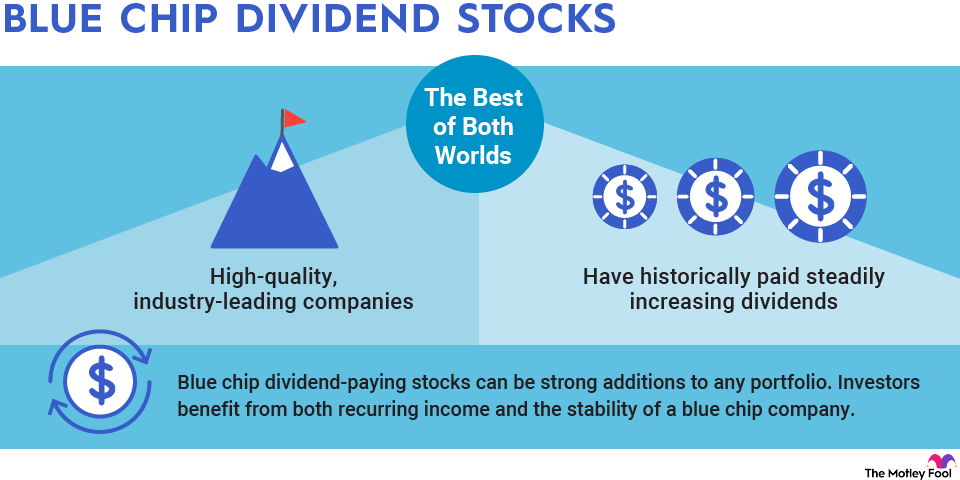
Blue chip stocks represent ownership in some of the most well-established, industry-leading companies in the market. These are businesses with large market capitalizations, resilient business models, and long track records of strong returns.
Included in major stock market indexes and respected by both consumers and shareholders alike, these companies have proven their ability to weather economic downturns while continuing to grow. Most also pay regular, increasing dividends, meaning shareholders earn consistent cash returns simply for holding shares.
Their combination of stability, performance, and income potential makes blue chip stocks a favorite among conservative investors, though even risk-tolerant investors benefit from their portfolio-steadying qualities. With that in mind, here are the top blue chip stocks worth considering today.

Top blue chip stocks to consider
Even if you've never invested in the stock market, you'll recognize the names of many top blue chip stocks. These large-cap companies provide products and services that billions of people worldwide use daily.
Here are five of the best blue chip companies on the market:
| Blue chip company | Market cap | Dividend yield | Industry |
|---|---|---|---|
| Apple (NASDAQ:AAPL) | $3.9 trillion | 0.39% | Technology Hardware, Storage and Peripherals |
| Berkshire Hathaway (NYSE:BRKA) | $1.1 trillion | 0.00% | Diversified Financial Services |
| Coca-Cola (NYSE:KO) | $343.4 billion | 2.56% | Beverages |
| Johnson & Johnson (NYSE:JNJ) | $584.4 billion | 1.61% | Pharmaceuticals |
| American Express (NYSE:AXP) | $237.7 billion | 0.95% | Consumer Finance |
1. Apple
Apple (AAPL +1.54%) is one of the world's most profitable companies. Throughout its history, it has pioneered advancements in the technology sector.

NASDAQ: AAPL
Key Data Points
The company innovated with its Macintosh computers in the 1980s and made media portable with its iPods in the early 2000s. Its iPhones, iPads, and Apple Watches are ubiquitous today. In a world where consumers flock to the latest tech fads, Apple's products enjoy notable loyalty from its customer base.
Apple also earns recurring revenue through its services, which include iTunes, the App Store, and its streaming television businesses. In 2018, Apple's market capitalization climbed past the $1 trillion mark to an unprecedented $2 trillion in 2020. The tech giant then became the first company to reach a $3 trillion market cap. Its valuation marched even higher from there, surpassing $4 trillion in late 2025.
While the company's valuation has sometimes fluctuated in conjunction with volatility in the broader market and business-specific developments, the tech giant's stock has been an excellent performer for long-term investors. Apple has been among the largest public companies for a long time, and the business still has room for growth over the long term.
2. Berkshire Hathaway
Berkshire Hathaway (BRK.A +0.05%)(BRK.B +0.15%) is a major player in the insurance industry. Through its subsidiaries, Geico and Gen Re, Berkshire offers various lines of commercial and personal insurance. However, Berkshire also owns a diverse set of businesses.

NYSE: BRKB
Key Data Points
For example, Berkshire owns restaurant chain Dairy Queen, railroad giant BNSF, and utility company Berkshire Hathaway Energy. It also owns water companies, consumer apparel businesses, battery brands, and more.
Beyond its subsidiary businesses, the investment conglomerate owns a large portfolio of publicly traded stocks. With such a broad range of businesses, the company has a reputation for safety, security, and consistent performance.
At the end of 2025, Warren Buffett stepped down as Berkshire's CEO and was replaced by his protege Greg Abel. Berkshire Hathaway is the only stock on this list that isn't a blue chip dividend stock, but it's possible the company could institute a payout under Abel's leadership.
3. Coca-Cola
Coca-Cola (KO +1.09%) has been a leader in the beverage industry for more than a century, with its namesake soft drink spawning a global empire. Yet, Coca-Cola has also changed with the times and now provides a much broader array of products, including juices, sports drinks, and bottled water tailored for more health-conscious consumers.

NYSE: KO
Key Data Points

NYSE: JNJ
Key Data Points

NYSE: AXP
Key Data Points
It's more than 170 years old, but it's staying relevant. The company's cards have surged in popularity among millennials and Gen Z consumers. Those younger age demographics are driving account registrations and accounting for a third of overall spending through the AmEx network.
American Express' management believes it can expand profits at a double-digit pace in the years to come. It plans to pay out roughly a quarter of its profits as shareholder dividends and announced a 17% increase in its dividend in March 2025. Ongoing earnings growth should lead to additional increases in future years.
Why you should invest in blue chip companies
Blue chip stocks are smart choices for investors of all kinds. Beginners will likely recognize the products and services these companies offer, making it easier and more exciting to get started, while experienced investors can draw on years of knowledge about how these businesses have performed over time.
Investors at every level can appreciate the general stability and reliability that blue chip companies provide, including strong dividends and payout growth streaks that have earned many of them a spot among the Dividend Kings, companies that have increased their dividends for at least 50 consecutive years.
Risks of investing in blue chip stocks
Even the most established players can lose market share to competitors, and new innovations can sometimes disrupt their business models entirely. Blue chip stocks also tend to trade at valuation premiums, since investors are willing to pay more for companies with proven track records. That means any signs of weakening performance can trigger sharp price declines, as investors become less willing to pay a premium for competitive advantages that no longer appear intact.
How to invest in blue chip stocks
- Open your brokerage app: Log in to your brokerage account where you handle your investments.
- Search for the stock: Enter the ticker or company name into the search bar to bring up the stock's trading page.
- Decide how many shares to buy: Consider your investment goals and how much of your portfolio you want to allocate to this stock.
- Select order type: Choose between a market order to buy at the current price or a limit order to specify the maximum price you're willing to pay.
- Submit your order: Confirm the details and submit your buy order.
- Review your purchase: Check your portfolio to ensure your order was filled as expected and adjust your investment strategy accordingly.
Tips for investing in blue chip stocks
- Measure the company's sales and earnings profile and growth outlook against its market capitalization.
- Prioritize investing in blue-chip companies that have been steadily growing gross margins and operating-income margins.
- Look for companies with proven management teams.
- Macroeconomic trends are difficult to predict, so look for companies that are capable of adapting to inflationary pressures and other dynamics.
- Measure a company's dividend-growth rate against the rate of inflation.
- Consider competitive dynamics that could shape performance in a company's key product and service categories. Blue-chip companies often dominate valuable markets, but they are not immune to disruption.
- Try to back companies that have defensible moats over the long term.
Future outlook for blue chip stocks
Blue chip stocks remain a reliable way to participate in market growth while limiting downside risk, but investors should keep a close eye on two major trends.
- Artificial intelligence looks poised to significantly shape blue chip performance over the next decade, benefiting some companies while forcing others to adapt or risk disruption.
- Geopolitical volatility is another key factor, as instability could create tailwinds for certain defense and materials companies while threatening supply chains and weighing on valuations across most sectors.
That said, nearly every investor can benefit from holding blue chip stocks in their portfolio, though the right allocation will vary depending on individual risk tolerance and financial goals.