Not an IRA
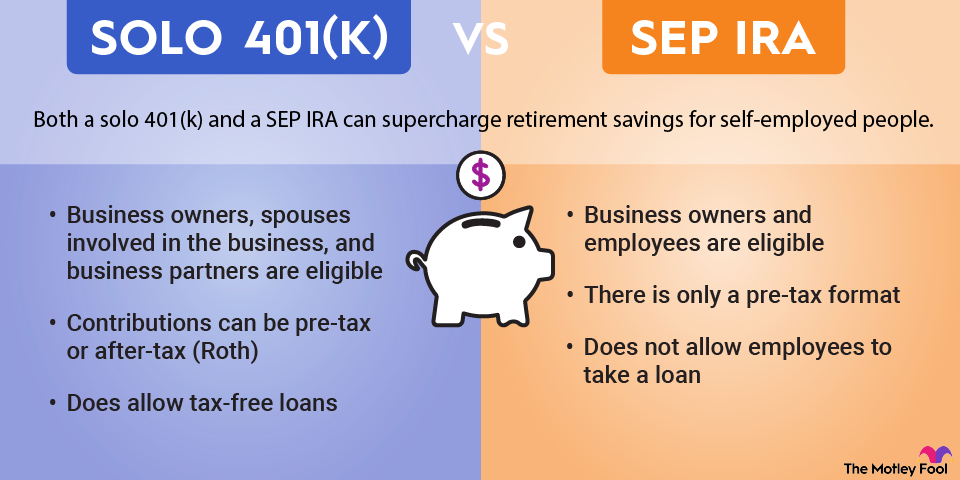
An interesting advantage of a solo 401(k) is that it's a 401(k) account and not an IRA. This is particularly useful for higher-income individuals who aren't eligible to contribute to a Roth IRA but are interested in taking advantage of the backdoor Roth IRA strategy. Doing so requires a nondeductible contribution to a traditional IRA and then a conversion to a Roth IRA.
But for the strategy to work, you must have only after-tax funds in your IRAs. If any IRA you own, including a SEP-IRA, has pre-tax funds in it, you'll get hit with an extra tax bill based on the ratio of after-tax to pre-tax funds in your IRAs.
Using a solo 401(k) avoids the problem of mixing pre-tax and after-tax funds in an IRA. It also enables individuals to roll over pre-tax funds from existing IRAs into the solo 401(k) in order to execute the backdoor Roth strategy in the future.
Advantages of a SEP-IRA
A SEP-IRA may be a better option than a solo 401(k) for some entrepreneurs. Here are a couple of examples:
It can support a growing business
If you expect to hire new employees in the near future, a SEP-IRA will cover you and your employees. A solo 401(k) covers only a self-employed individual and their spouse (if they also work in the business), but a SEP can be expanded to all employees.
Importantly, contributions from a SEP for each employee must be the same percentage of compensation for each employee. But the business owner has greater control over what percentage they contribute in any given year, ranging from 0% to 25%.
Contribution limits
A SEP-IRA has the same overall contribution limit as a solo 401(k). The only difference is that there's no elective employee contribution portion with a SEP-IRA, just the profit-sharing portion. Profit-sharing contribution limits follow the same rules as solo 401(k)s -- 25% of compensation or 20% of net income if you're self-employed -- and the overall contribution cannot exceed $70,000 in 2025 and $72,000 in 2026. In 2025, only the first $350,000 could be used to calculate compensation. In 2026, this limit increases to $360,000.
For a self-employed person to max out their SEP-IRA contribution limit in 2025, they'd need to earn $350,000 and contribute 20% of their net income, or $70,000.
Solo 401(k)s often have higher limits
Here's one very important difference. You could max out a solo 401(k) with significantly less business income because $23,500 can come from your employee-side contribution in 2025 ($24,500 in 2026).
It's also worth noting that because all SEP-IRA contributions are considered to be employer contributions, there are no catch-up contributions allowed if you are 50 or older.
In short, if you are a high earner or you're over 50, the solo 401(k) will likely have a higher contribution limit for you.
Which is better for you?
Both a solo 401(k) and a SEP-IRA can significantly boost retirement savings for self-employed individuals. The solo 401(k) will typically allow them to contribute more to their retirement savings and offers greater flexibility for optimizing taxes both in the present and in retirement.
But there are several circumstances where a SEP-IRA may be a better option. For example, if you hire new employees in the future, you'd need to upgrade a solo 401(k) plan to a small business plan, which can be much more costly. If you plan to hire employees down the line, a SEP-IRA may be the right choice for you.
Furthermore, if you participate in and max out a 401(k) or similar retirement plan from another job, your ability to contribute to a solo 401(k) is greatly reduced. In that case, a SEP-IRA may be a better choice due to its simplicity.
You can opt for both if you choose. Keep in mind that the contribution limit for the SEP-IRA will be limited by the profit-sharing contribution in the 401(k). They cannot exceed 25% of the total compensation. There's no double-dipping, so there's little value in establishing both retirement plans. Pick one and go with it. You can always change things in the future if circumstances change.
Related retirement topics