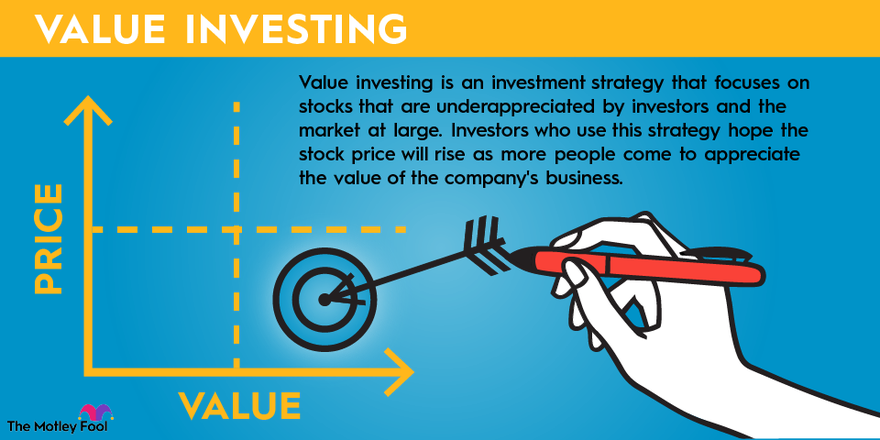
Despite a bull market that began in 2023, value investors hunting for a good bargain can still find undervalued companies hiding in plain sight.
An undervalued stock is a publicly traded company that's trading for less than it should be, often because of overblown short-term concerns rather than any fundamental problem with the business. These companies tend to be consistently profitable, carry attractive long-term growth prospects, and trade at a discount to peers and to the future profits they're expected to generate. For patient, buy-and-hold investors, they can represent some of the best opportunities in the market.
That said, not every cheap stock is a bargain. Some stocks are cheap for a reason: slowing growth, mounting losses, or intensifying competition. These are known as value traps, and they're worth avoiding even if the price looks tempting on the surface.
Top 6 most undervalued stocks in 2026
| Company name | Market cap | Dividend yield | Industry |
|---|---|---|---|
| Berkshire Hathaway | $1.1 trillion | 0.00% | Diversified Financial Services |
| Berkshire Hathaway | $1.1 trillion | 0.00% | Diversified Financial Services |
| Lululemon Athletica Inc. | $22.0 billion | 0.00% | Textiles, Apparel and Luxury Goods |
| Micron Technology | $481.9 billion | 0.11% | Semiconductors and Semiconductor Equipment |
| British American Tobacco | $134.7 billion | 5.11% | Tobacco |
| Lennar | $28.8 billion | 1.72% | Household Durables |
1. Berkshire Hathaway

NYSE: BRKB
Key Data Points
2. Lululemon Athletica

NASDAQ: LULU
Key Data Points
Lululemon Athletica offers an example of a different kind of undervalued stock: a turnaround play.
Lululemon, the company that pioneered the athleisure category, has long been seen as a growth stock and carried a premium valuation. However, in 2025, the stock tumbled, losing more than 50% of its value at one point, as comparable sales growth in the core Americas segment turned negative.
The challenges got bad enough that CEO Calvin McDonald said he was stepping down, and the company would begin a search for the next CEO.
A combination of product missteps and weak consumer spending in North America has sunk the stock, but those seem to be problems the company can overcome with time. Additionally, it's delivering strong growth in China and is still opening new stores domestically and around the world, showing it has a long runway for growth.
In mid-December 2025, the stock traded at a price-to-earnings (P/E) ratio of just 16 based on its updated guidance for the year. That's almost half the price of the S&P 500 for a stock that still has a lot of long-term growth potential.
3. Micron Technology

NASDAQ: MU
Key Data Points
4. British American Tobacco

NYSE: BTI
Key Data Points
5. Lennar

NYSE: LEN
Key Data Points
Why do stocks become undervalued?
Stocks can fall below their true value for several reasons, and understanding those reasons is key to separating genuine bargains from value traps.
- Short-term market bias is one of the most common culprits. A single bad earnings report can trigger a steep sell-off, even if the long-term business remains intact. These overreactions can set up attractive entry points for investors willing to look past a rough quarter.
- Macro conditions like rising interest rates can also depress valuations across entire sectors, regardless of individual company quality. These conditions are typically temporary, and buying cyclical or rate-sensitive stocks during periods of macro weakness has historically been a winning strategy.
- Narrative mismatch is another factor. When AI stocks were soaring, investors poured money into that story and largely ignored everything else, even high-quality businesses with solid fundamentals. Stocks that don't fit the prevailing market narrative can quietly become some of the best values around.
How to find undervalued stocks
There's no universal formula for finding undervalued stocks, but a few metrics can point you in the right direction. Don't just focus on whether a stock looks "cheap" relative to its 52-week low -- prices can always go lower. Instead, evaluate the underlying business.
- Profitability: Look at key metrics like operating margin and profit margin. Consistently high margins relative to peers indicate strong profitability.
- Return on equity (ROE): ROE measures how effectively a company uses shareholders' equity to generate profits. A higher ROE, typically above 10%, is a good sign of management efficiency and profitability.
- Return on assets (ROA): ROA indicates how efficiently a company uses its assets to generate profit. ROAs above 5% are generally considered good, but can vary by industry.
- Price-to-earnings ratio: The P/E ratio measures how much investors are paying for a company's earnings. Comparing the P/E ratio to that of the S&P 500 is one way to get a sense of the relative value of a stock. You can also compare a company's P/E ratio to its peers.
- Price-to-book ratio (P/B): A P/B ratio under 1 suggests the stock may be undervalued, but be cautious, as a very low P/B could indicate underlying problems. Compare it with the industry average for context.
- Earnings growth: Sometimes a stock is undervalued for a reason, such as poor growth prospects. Check the company's historical and projected earnings growth rates. Consistent growth is a positive indicator, while declining earnings could be a red flag.
- EV/EBITDA: This ratio compares a company's enterprise value (EV) to its earnings before interest, taxes, depreciation, and amortization (EBITDA). It provides a more comprehensive view than the P/E ratio because it factors in a company's debt. Ensure you compare the EV/EBITDA ratio to peers within the same sector to gauge relative value.
Benefits and risks of undervalued stocks
Like any other group of stocks, there are both benefits and risks to investing in undervalued stocks. Let's take a look at both sides of the coin here.
Benefits:
- Undervalued stocks are well set up to outperform the market. If the investment thesis is correct, the stock should outperform as the price moves higher to reflect the true value of the stock.
- Undervalued stocks often pay higher dividend yields since yields go up as price goes down.
- They tend to be lower-risk stocks since their price is already down.
Risks:
- The biggest risk in undervalued stocks is that you're wrong in your assessment and that the stock is a value trap.
- The stock can remain undervalued for longer than you expect.
- Market conditions change and push the stock even lower.
How to invest in undervalued stocks
- Open your brokerage app: Log in to your brokerage account where you handle your investments.
- Search for the stock: Enter the ticker or company name into the search bar to bring up the stock's trading page.
- Decide how many shares to buy: Consider your investment goals and how much of your portfolio you want to allocate to this stock.
- Select order type: Choose between a market order to buy at the current price or a limit order to specify the maximum price you're willing to pay.
- Submit your order: Confirm the details and submit your buy order.
- Review your purchase: Check your portfolio to ensure your order was filled as expected and adjust your investment strategy accordingly.
Common mistakes to avoid
The most common mistake with undervalued stocks is confusing a value trap for a genuine bargain. The key distinction: undervalued stocks face temporary headwinds, while value traps are declining businesses whose low valuations reflect permanently diminished prospects. It's not always an easy call, but asking whether the company's core problem is fixable is a good starting point.
Timing is another pitfall. Even when you've correctly identified an undervalued stock, buying too early can mean watching it fall further before it recovers. Stocks tied to macroeconomic factors, like interest rates or economic growth, can stay depressed longer than expected. Building a position gradually rather than all at once can help manage that risk.
Related investing topics
FAQ
Undervalued Stocks FAQ
About the Author